Thirteen days, in pictures
One picture from each stretch of the history, oldest on the left: code-built concepts, the first generated interiors, the first arena, the drill, a Harrow hall, a boss, cities, armour and cloth, then the new skill bar, boss arenas and the loadout. Scroll sideways.
The eras
The plan lives in PLAN.md and the stories on a project board; these sections group the history by what it set out to do. Some pictures are AI-made concept art, and each says so.
A name, a pitch and a walking proof
Day one, 5 October: a pitch, a roadmap, design docs and concept scenes drawn in code, then a bought character walking, fighting and being animated in the browser by the same evening. The game was still called Undertone.
Generated levels, and the owner’s verdict
Two attempts at generating levels, and one blunt playtest. The generator was rebuilt as explorable zones, filled with a station kit, and then judged by the owner to be really bad. The fix was to stop placing individual pieces by rule.
A room builder, and kits to build with
If the code cannot place pieces well, the owner will. A room builder that works on a phone, online behind a login, with new art kits to feed it. Along the way: transparent troopers.
A board, a new name and a playable demo
One long night: a roadmap board with 164 stories and 17 role agents, the rename to Hush Money, ten playable bodies, a first demo with troopers fighting back, synthesised sound, effects in code and a character-creation screen.
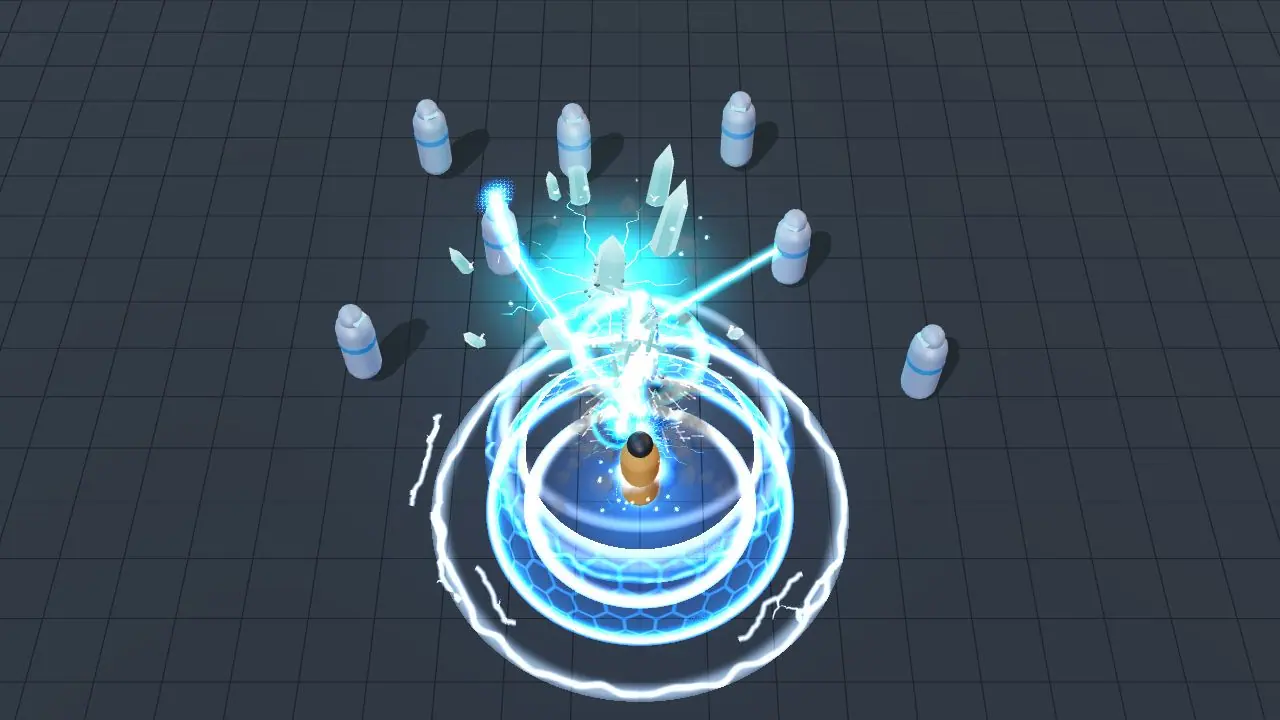
Feel, phones and layered maps
The first real playtest said combat felt clunky. A feel pass, realistic effects, troopers that find their way, device tiers for phones, EU hosting, and the idea that levels should have sky, ground and underground.
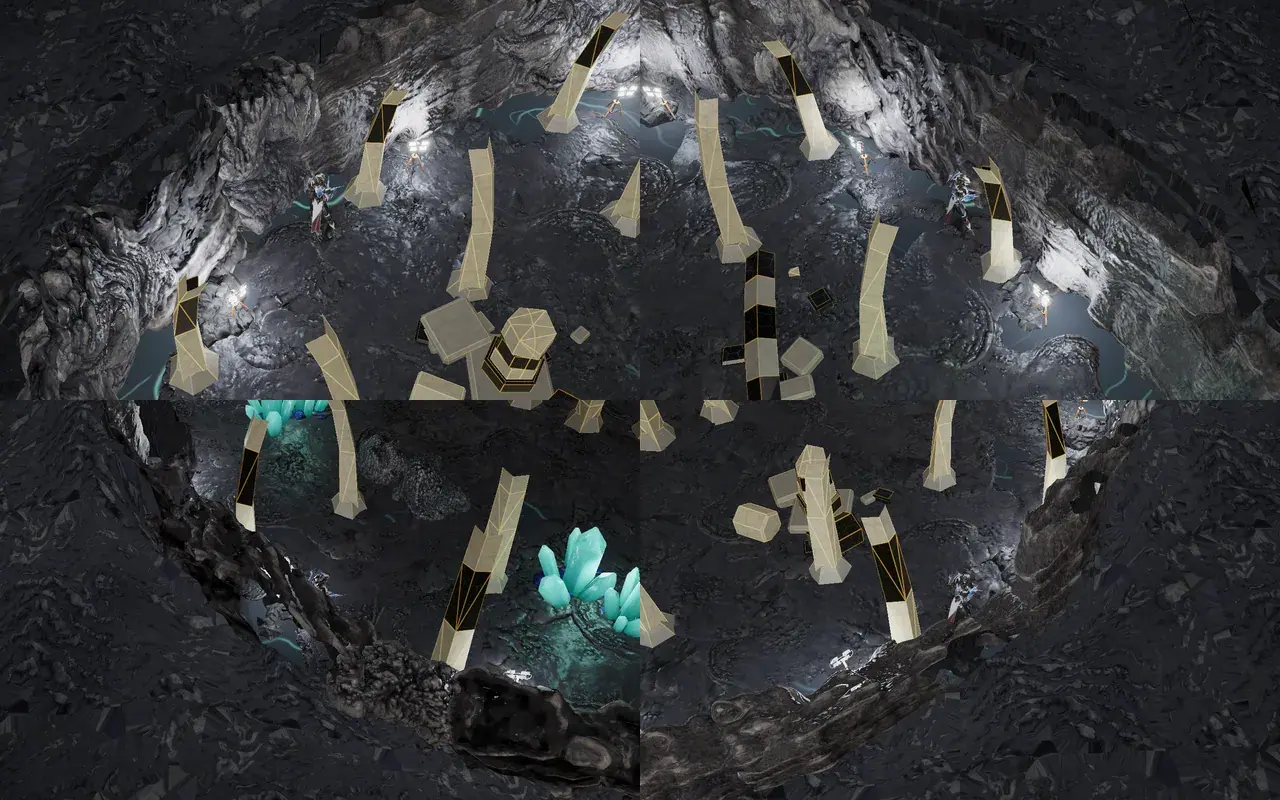
The room library, caves and the drill
Small-model agents designed rooms, the owner walked them and flagged what was wrong, and a library grew from 54 rooms to 255, with caves, round rooms, descents, a Harrow style that looked cheap and a Deep-Core Drill that was rebuilt twice.
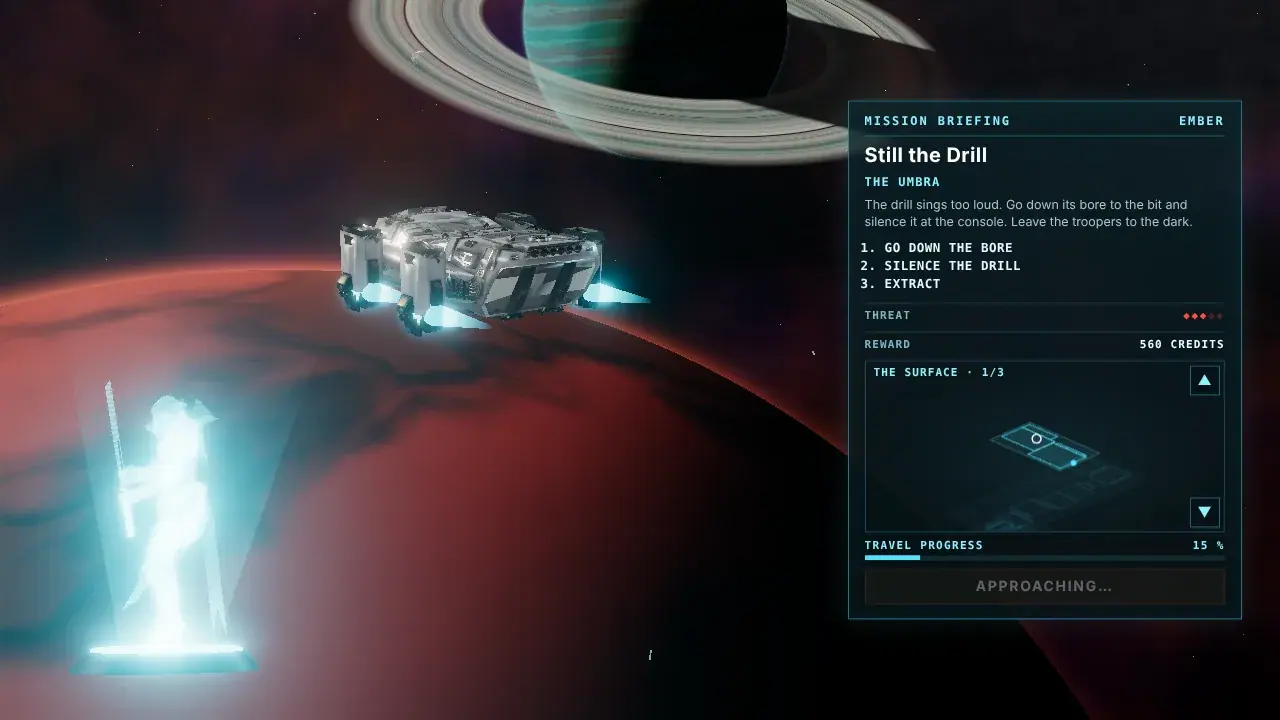
One weekend to a whole game
The owner asked for everything hooked together: missions, travel, profiles, progression, co-op, raids, assaults, cities, native sites and a second faction. Several agents worked in parallel against one contract.
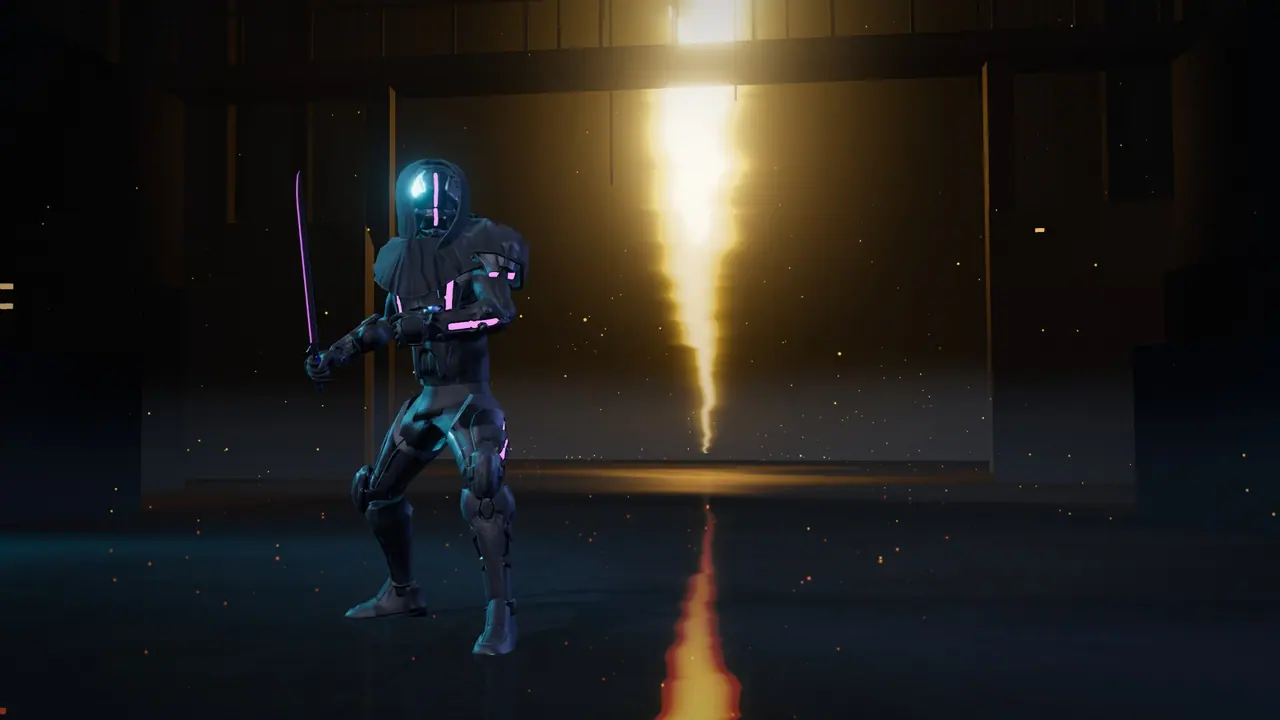
Modular freelancers, armour and concept art without credits
The freelancer became a set of parts. Seven armour sets and ten weapons were designed and built, concept art moved to a cheaper image model, and a boss that could be shot from 25 m was reworked.
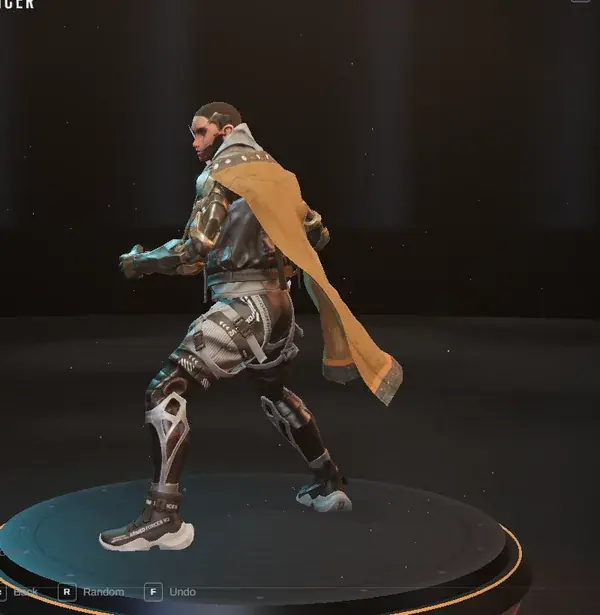
Cloth, coats, shields and a tune-up
Capes with physics, a greatcoat, all seven shields and a power shield, a performance sweep, renders on the GPU, and a repo that finally has the right name.
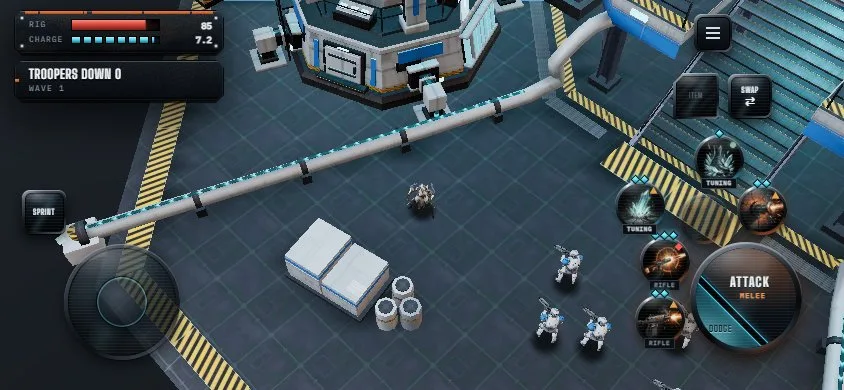
A release button and a new skill system
A release pipeline and three hitch fixes, then the owner's call to rebuild the skills: block off every button, a tree per weapon, a bar of six, painted icons, one bindings table and a touch layout with a split attack and dodge button. Designed, answered and playable in one evening.
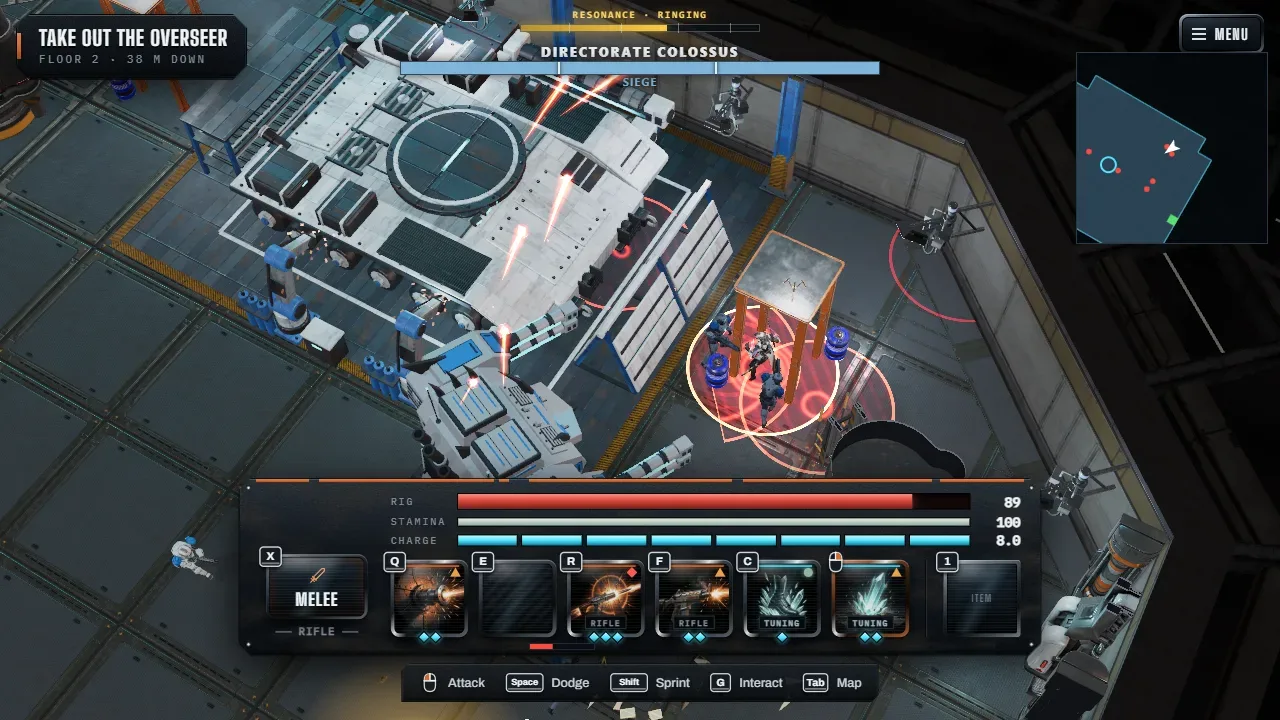
Rooms a boss can be fought in, and prices that take work
After a phone playtest, bosses only appear in rooms with space to fight them, and seven new arenas at three depths were built. Prices and levelling were set against 55 measured runs, and the desktop skill bar got smaller.
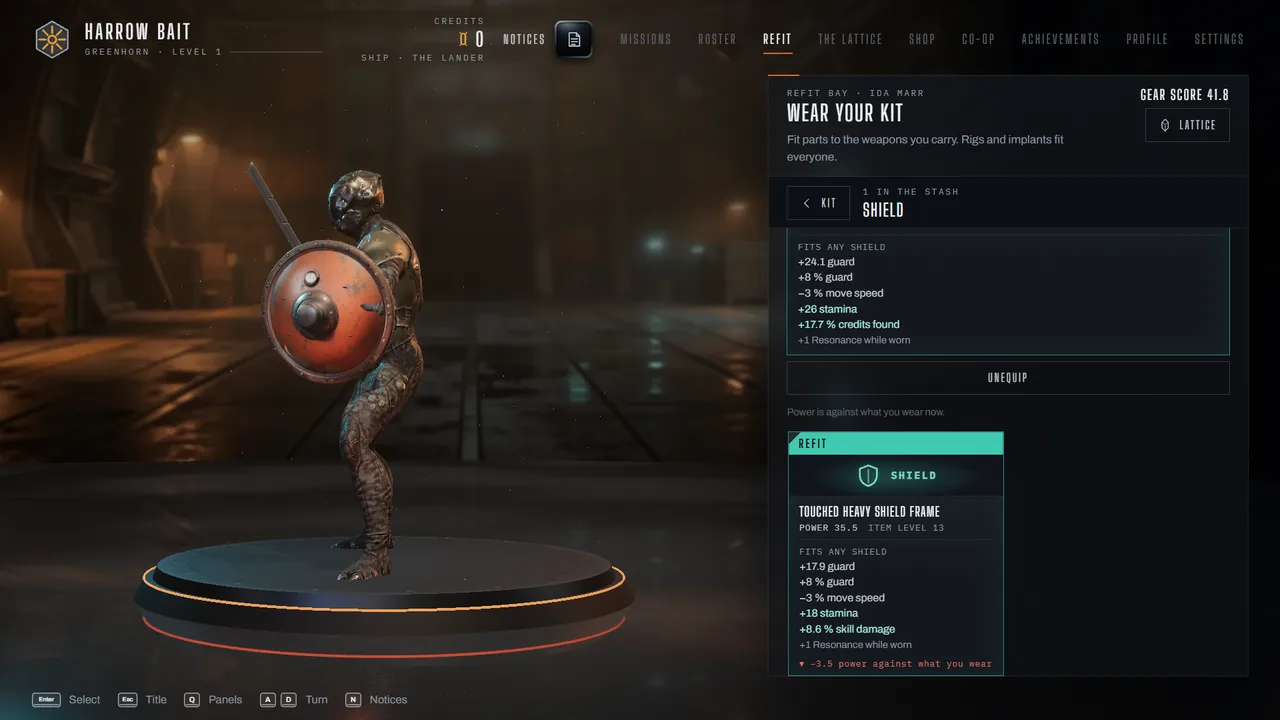
A bar per weapon, a quick-swap pistol and an iPhone build
The loadout settled: a skill bar for each weapon, the pistol as the gun you swap to, a slot picker on the phone, frames that fit their weapons, a notice centre, and an iOS shell that builds test versions from develop.
What the plan still holds
From PLAN.md on 17 October: phase 0, pre-production, is still open with the skills rework inside it; the foundation phase, the hub and the release candidate follow. The board has 623 issues, and 183 of its items are done.
A name, a pitch and a walking proof
Day one, 5 October: a pitch, a roadmap, design docs and concept scenes drawn in code, then a bought character walking, fighting and being animated in the browser by the same evening. The game was still called Undertone.
- 1 5 Oct
Phase 0: a name, a pitch and a plan
doneThe repository starts on 5 October with the paperwork a game needs before any code. A pitch, a roadmap with phases 0 to 14, design docs for the world, the core loop, five tech disciplines, items and set-pieces, and a visual style called work lights in the dark.
The game is a browser action RPG in the Cantorite universe, the Vesper Reach of Harrowfall. You are a freelancer, and the hook is Resonance: everything loud you do pays better and wakes the Harrow. It was still called Cantorite: Undertone, after the sound under the sound.
A read-only research agent checked the lore against the Harrowfall repo before anything was written down as canon.
Harrowfall supplied the stack and the habits: TypeScript, the same 3D and build tools, hosting in the EU, design before code, budgets as CI checks. The rules came across in the first commit.
b6c254e4The contract-board mockup from the pitch site. The file in the repo was re-rendered after the rename, which is why it already says Hush Money. Mockup · 5 Oct - 2 5 Oct
Concept scenes, drawn in code
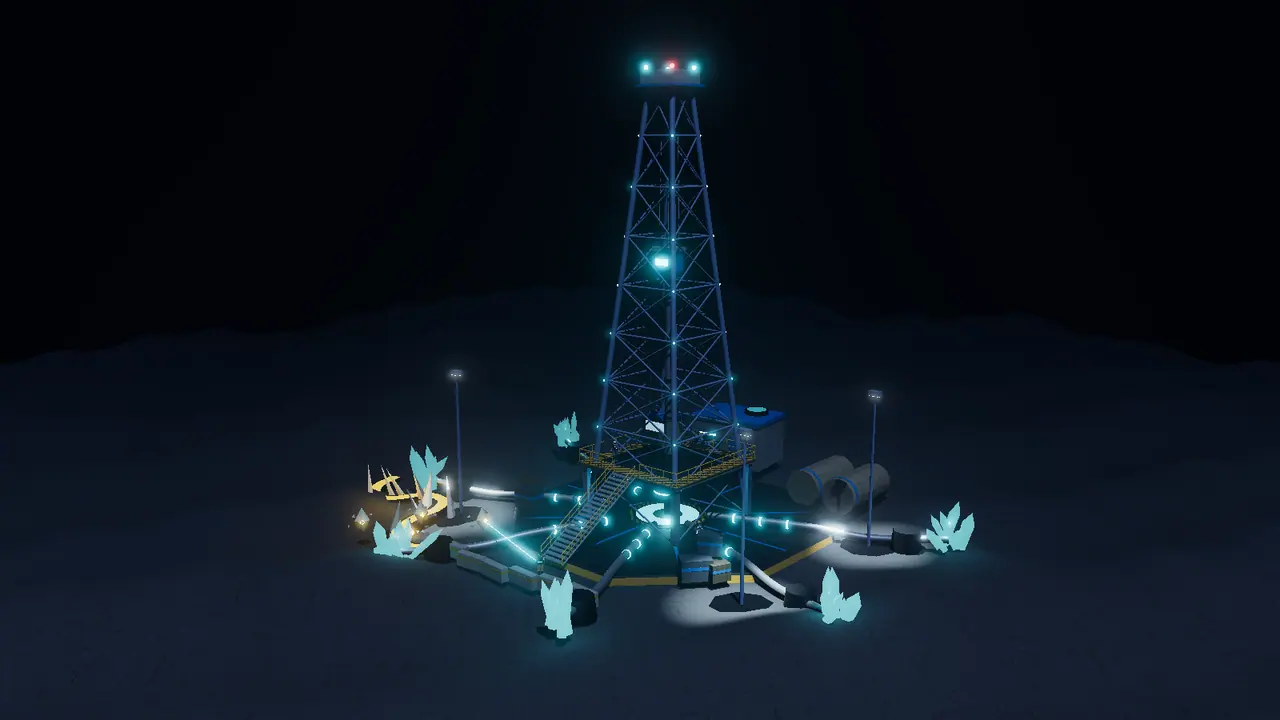
doneBefore any art existed, 3D scenes were built in code and rendered headless to PNG: the Deep-Core Drill site at walkable scale, a freelancer in five discipline loadouts, and Fallow with a dormant faceted titan standing in the sand.
The same commit added a static pitch site and mockups of the main menu, the contract board and the HUD, with self-hosted fonts and no runtime requests to outside services.
Roadmap: show the look before committing to it. A concept made from code costs nothing and can be re-rendered when the direction changes.
dadffe86The Deep-Core Drill site, built in code: the first picture of the game. From the repo · 5 Oct Fallow, the endgame world, with a dormant faceted titan. From the repo · 5 Oct One freelancer in five discipline loadouts. From the repo · 5 Oct The same drill from the gameplay camera, about five times closer than Harrowfall's. From the repo · 5 Oct - 3 5 Oct
Two promises: no console lock-in, melee that matters
doneTwo decisions went into the docs within the first hours. Consoles are a nice-to-have, not a target: the stack cannot ship on PlayStation or Switch as it is, so the plan keeps a port cheap instead, with controller-first input and menus, a pure TypeScript simulation, the renderer and platform services behind interfaces, offline play and Switch-class Low budgets. The Steam Deck is the controller proving ground.
The second: melee is a first-class pillar. Every discipline gets a real melee path (the Bulwark maul and Breach Ram, a Veil blade, a Graft gauntlet, a Tuning glaive), and melee is in the first combat phase, not bolted on later.
Roadmap: keep every option for the platform and every discipline for the fight, while the code is still small enough to change.
babf9061 - 4 5 Oct
The character proof: a bought hero, walking and fighting
doneThe ARPG camera is about five times closer than an RTS camera, so characters are the art risk. The first proof took one bought character pack and put it in the browser at full quality: runtime PBR materials per slot, translucent energy for the shield, alpha-tested hair, with the models kept out of git until the licence was confirmed.
Then came animation. Motion-capture clips were retargeted onto the skeleton offline in a headless 3D tool, 207 clips across four packs, with root motion pulled out to a per-clip curve. On top of that sits a playable demo: a follow camera, a three-hit combo with input buffering, a soft target lock, hit-stop at the measured hit frame, dash, block, and keyboard, gamepad and touch controls.
A third step added a gallery for a second bought pack: a soldier, a pilot and a mech suit. The awkward bit was that one pack's clip files disagreed with its mesh files about the rest pose, so played raw they lay flat on the floor. The retargeter learned to cope.
Roadmap: the first art milestone is one body at final fidelity, before any enemy variety. Everything after this builds on that retargeting pipeline.
853027d7 - 5 5 Oct
A level designer before there were levels
doneThe first generator laid a macro loop around a reserved set-piece, carved it by archetype, populated it along a pacing curve, analysed it with Dijkstra and rerolled until the hard checks passed. A page at /levels.html shows five contract templates with overlays and metrics, and walks the level at the game camera.
On 30 seeds of five templates every level passed its hard checks. That sounded good. The next morning the owner played one.
Roadmap: levels are the product in an extraction game, so the generator came before the combat did. The same evening an animation downloader was written for the owner's account, signing in through a visible browser on the owner's machine.
26838f27
Generated levels, and the owner’s verdict
Two attempts at generating levels, and one blunt playtest. The generator was rebuilt as explorable zones, filled with a station kit, and then judged by the owner to be really bad. The fix was to stop placing individual pieces by rule.
- 6 6 Oct
Levels v2: zones with loops instead of a corridor
doneThe first generator played as a corridor: one ring of rooms, 10 to 24 percent of the area walkable, the exits next to the job. It was rebuilt as zones, regions of open ground on a 24 m grid, with a region graph that adds passages between regions far apart in the spanning tree, so there are several big loops.
The job hides part-way in, there are two exits in different directions, and points of interest are dealt from a deck for each contract. One slider runs from campaign zone to farming run. New checks measure walkable share, ground explored before the job, junctions per 100 m, exit angle, and run-to-run variety.
Roadmap: a 12-minute run you want to repeat needs levels that differ from run to run. The same commit opened ticket T8 for the kit licences and purchases.
14415df5 - 7 6 Oct
Bore Seven’s interiors on the station kit
doneAn interior is built from a bought station kit on its own 4 m grid: a hub with corridors to each exit and seven room kinds, pump hall, control, cargo, server, lab, store, maintenance. All 111 usable pieces were exported with their textures, and an interior draws as one batch per material, about 58 draws. A gallery at /kit.html shows every piece.
The same morning a walk page appeared, where the first character can run through the generated levels at the game camera. It also taught a lesson about lighting. The lights had been tuned on headless screenshots that only render a few frames, while the real light pool fades in over a third of a second, so on a real GPU everything came out two to three times too bright and the bloom washed it white. The fix was to settle the pool before judging, raise the bloom threshold and add eye adaptation, so the showcase's upper decks stopped whiting out.
Roadmap: prove that a bought kit can be assembled by code into buildings you fight through.
660ca1d4A generated Bore Seven interior at the game camera, before the redesign. Shot later for the before-and-after comparison. From the repo · 6 Oct - 8 6 Oct
The Directorate’s drill, generator and trooper
doneIn parallel an art session rebuilt the Directorate's look at the new camera distance: the Bore Seven drill, the generator, and a trooper from a bought model run through the animation pipeline. Textures moved to KTX2 through one shared loader with a WebP fallback.
The point of the comparison pictures is how much more there is to see at this distance. Harrowfall's tiny RTS unit becomes a character you look at for a whole run.
Roadmap: the first enemy line is the Directorate, because the Deep-Core Drill the RTS player builds becomes the level you climb.
b0c3b073Harrowfall's Deep-Core Drill (left) beside the Bore Seven drill rebuilt for this game. From the repo · 6 Oct The RTS armoury trooper beside the new trooper, common and elite. From the repo · 6 Oct - 9 6 Oct
“Really bad”: the owner plays the interiors
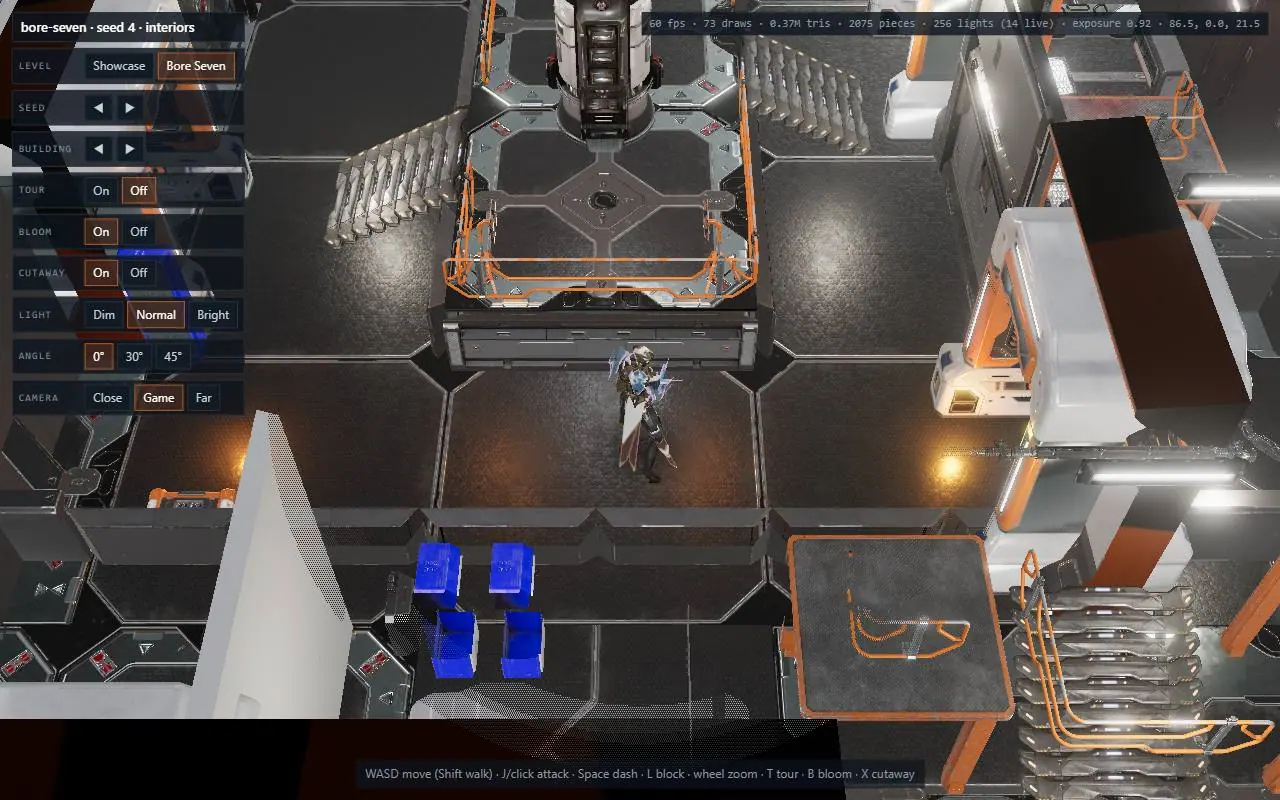
doneThe owner played the generated interiors and was blunt: dead ends, very small rooms, stairs that lead nowhere. The agent measured before it argued. Over ten seeds and 41 buildings, 678 of 783 rooms had no 8 by 8 m square of floor, 548 dead ends had nothing in them, and on the walk page's own collision 79 of 218 stair tops could not be reached. Three buildings could not be entered at all.
The v3 redesign took the kit's own demo station as the model: a hall wall to wall, a railed dais in the middle, wide stair banks up to galleries. Then the owner walked the result and was not impressed. Lights standing in the middle of nowhere, floating pieces, doors that lead nowhere, railings dropped at random. The question was whether the generator could make levels that work at all, and the owner would rather drop the idea than keep these.
“Are you even able to generate levels that would work?”
20a88b62Before the v3 redesign: seed 4, building 1. From the repo · 6 Oct After the v3 redesign: the same seed. Clearer, and still not good enough. From the repo · 6 Oct Floor plan, before: a maze of small cells. From the repo · 6 Oct Floor plan, after: halls with side rooms. From the repo · 6 Oct - 10 6 Oct
Stop placing pieces by rule
doneThe diagnosis was simple. The v3 generator placed about 2,800 kit pieces by rule, a lamp on a wall strip, a railing on a deck edge, a gate in a wall, and every rule has edge cases: a wall that is low, a deck turned the other way, a wall with nothing behind it. Its checks measured the floor plan, not the pieces, so nothing asked whether a lamp had a wall.
The proof that replaced it uses hand-built rooms joined at gates. Generated shells, artist-made clusters only. A research agent surveyed published methods, and the answer to the owner's question, why not use a published method and plot the assets on it, was room templates with configuration spaces, driven by a hand-written catalogue of building flows that are built on cycles. Nothing that places single pieces by rule.
The owner tried the proof (a seed button on the walk page) and said the rooms now felt workable. Then came a request for hallways, rooms of different sizes, and grey placeholder rooms for the ones not yet designed.
After trying it, the owner: the rooms feel workable, but it has to feel like a real level, not what we had before.
728bc0caThe room-template proof: a hall built by hand, joined at gates. From the repo · 6 Oct A building plan from the proof, seed 1: rooms joined at doorways. From the repo · 6 Oct A gate between two hand-built rooms. From the repo · 6 Oct
A room builder, and kits to build with
If the code cannot place pieces well, the owner will. A room builder that works on a phone, online behind a login, with new art kits to feed it. Along the way: transparent troopers.
- 11 6 Oct
Could I just build the rooms myself?
doneThe owner's next idea was the one that stuck. A room builder, where the owner places the pieces, the result is stored as JSON, and the generator only decides which rooms to use and how to join them. That way the owner also decides sizes and hallways.
The builder stores drafts in a database and commits only a room marked final to git, so what the agents read is always finished work. Every save is kept as a version. A final room is read-only until it is set back to draft. Doorways are built closed, and when the generator joins one it swaps the wall for the kit's own gate.
Roadmap: let the person with taste place the pieces and let code do the joining.
dcd767bf - 12 6 Oct
Online behind a login, and fit for a phone
doneThe builder went to a development address behind a login with a one-time PIN, with the database in the EU. It took a few tries: one login application per hostname, because with both on one, a login came back to the wrong host. And at one point the assistant refused to create the login rule at all, on a safety check of its own, until the owner changed the permission mode.
Then the owner said they would mostly build on their phone. Within the hour the builder had a full-screen view, bottom tabs and sheets, tap to place or select, and no browser zoom. Placing a piece precisely by tapping was hard, so the next commit added arrow buttons that move a preview and a Place button, with a step size. Then double-tapping turned out to zoom the page, so zoom, scroll bounce and text selection were switched off on the UI.
Roadmap: whatever the owner finds comfortable gets used. The owner builds on a phone, so the builder had to work on one.
ce179884 - 13 6 Oct
Troopers you could see through
doneThat evening the owner noticed that all four trooper types had a transparent body under the armour. You could see the far shoulder through the chest. A first fix drew both sides of the material and it was still transparent, even as WebP.
The cause was the model reduction. The hidden-face cull had removed the inside of the plates and the undersuit beneath them: the reduced trooper had 3,616 open edges, the elite 7,372. The cull was turned off and only true specks are dropped now, leaving 220 and 361 open edges. A full, non-reduced model was added too, because the owner's view was that these models have to be good.
Owner: all troopers have a transparent body below the armour, so they seem broken.
2eb75d0f - 14 7 Oct
Kits: the station, the industrial yard
doneMore kits, so rooms could look different. An industrial pack came through the same kit pipeline: 634 pieces, with its textures repacked for the web, and its demo map walkable at /walk.html?level=industrial. Meshes that exist only inside the pack's source project were decoded from their mesh descriptions until all 8,616 of 8,616 placements were there, with the pack's own materials, sky, 94 decals and ground layers.
That evening the owner asked a sharp question: is it clear how the pieces of the pack connect, could you generate logical architecture for a generated map, or would you still have me build the maps? The answer was a yard generator proof that measures the joins from the demo's own placements and lays seven whole blocks out on a walled, paved site, plus a minimap for the walk page.
Roadmap: more kits means more variety for the builder's palette.
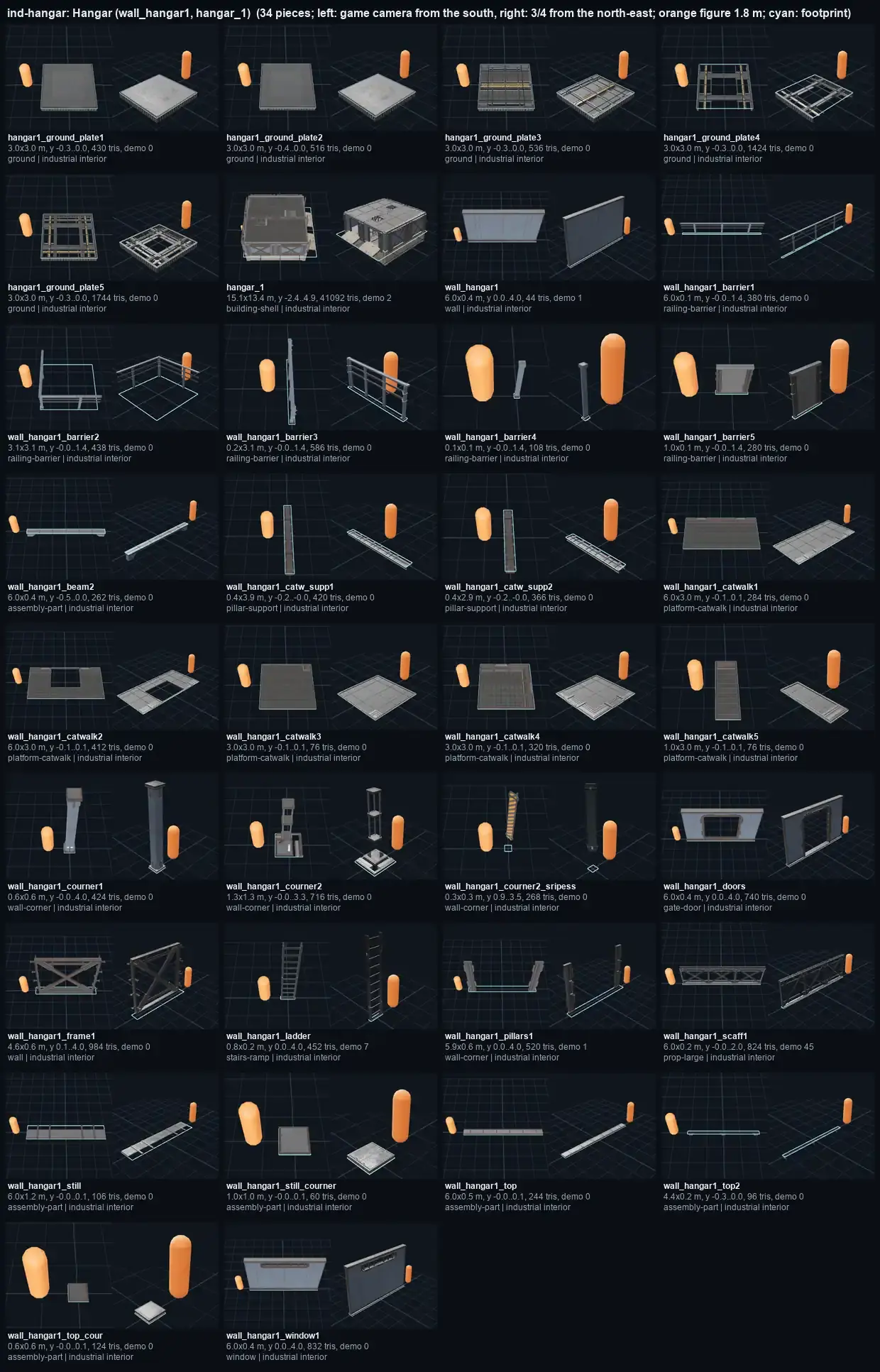
d58a5a7bA hangar from the Sci-Fi Industrial kit, from the catalogue renders made the next day. From the repo · 8 Oct
A board, a new name and a playable demo
One long night: a roadmap board with 164 stories and 17 role agents, the rename to Hush Money, ten playable bodies, a first demo with troopers fighting back, synthesised sound, effects in code and a character-creation screen.
- 15 7 Oct
A roadmap board and seventeen role agents
doneWith the level work handed to other agents, the owner asked the main session for a roadmap with tickets and user stories, as a project board like the one Harrowfall has, and for agent files for each role the work would need: lead designer, gameplay director, skill designer, UI designer, tester and so on.
The result is a sync script that turns PLAN.md and a JSON file of stories into issues on the board: one epic per phase, stories as sub-issues, fields for kind, phase, area, role, priority and size, and milestones M0 to M5. It started with 164 stories and 17 role agents. Later that night commits began to name their issue, and a commit saying Fixes #n closes it.
It was not flawless. Six of the agent files had a description with a colon in it, which made their front matter invalid YAML, so those agent types silently never loaded until someone quoted them the next morning.
Roadmap: with several agents working at once, the board is the shared memory. The count since then: 545 issues, 145 closed.
19f0ef51 - 16 7 Oct
Undertone becomes Hush Money
doneThe working title Undertone came from canon: near big cantorite fields the radio carries the Hum, and an undertone is the sound under the sound, the thing the freelancer learns to listen for. But a web search for it returned almost only a well-known indie RPG whose name is one letter away, and the owner asked for catchier options.
Round two weighed double meanings: the name should be the hook. Earshot was the top pick (out of earshot is the whole game). Hush Money was the strong second: the Hush, a faction in canon, pay you for silence, and the loud job pays more. Others were Pitch Dark, Loud Money, Last Toll. The owner said Hush Money it is, and within minutes the rename went through everything a player or the owner sees: page titles, wordmark, mockups, docs, agents and the board.
What kept the old name: identifiers nobody sees, the repository, the workspaces, the servers and the database names, because renaming a database would orphan the saved rooms. (The repository itself was renamed a week later; see the last era.)
Hush Money is two words that say the hook, and the faction was already canon.
862ea937The main-menu mockup, re-rendered with the new name. Mockup · 5 Oct - 17 7 Oct
Translatable from the first screen
doneOne rule went in before there was much to translate: no player-facing text inline. The simulation returns codes, the UI looks them up, and CI checks it. English is the source language and Dutch the first extra one, following the approach Harrowfall uses.
On 8 October a cloud session added the checks that make it real: a glossary with context for translators, a check script, Latin Extended-A fonts, a lint that forbids physical CSS where a logical property is needed, and a pseudo-language that stretches and brackets every string so overflow shows up in screenshots. Dutch is live as a preview.
Roadmap: retrofitting translations is miserable, so the rule is cheaper on day two than on day fifty.
fc387179The creation screen in the pseudo-language, which makes every label longer and bracketed so overflow is obvious. From the repo · 8 Oct - 18 7 Oct
Ten bodies, any species
doneThe owner pointed to five more character models from the same maker on top of the first character, and set the rule: every one of them is selectable as the freelancer, each with at least one melee weapon and a gun, some way to do magic, and a block. Animations and weapons may differ between them; for now only the appearance changes. They all need a high-definition version, because players look at them.
Two decisions followed the same evening. Looks may be any species, alien creatures included, and may use gold: the canon rule that gold belongs to the Harrow still holds for factions, enemies, UI and loot, but player bodies are exempt. And weapons are a shared pool, with the move set following the weapon class, not the body.
Roadmap: every bought character becomes a selectable look. Eleven by the next day.
bc0ed080The pack's lineup in a T-pose, measured for the design doc. From the repo · 7 Oct The same lineup from the game camera. From the repo · 7 Oct - 19 7 Oct
Animations: a whole motion library, and a generated-motion proof
doneThe motion library needs the owner's account, so the downloader signs in through a visible browser on the owner's machine. For a while the owner downloaded animations by hand while the tool caught up; its all command later fetched the whole library, resumable, skipping clips already there. It stalled more than once, and one bug saved the previous job's file as the new clip because the monitor lags the export. By the early hours the library stood at 2,435 verified clips, after mislabelled files were re-fetched.
In parallel, a proof of concept with a research motion generator: four of its sample motions retargeted onto the first character, with the licence read first (fine for use in the EU) and an owner ticket for the one open question.
Roadmap: animation is the second art risk after characters. A motion library of this size means no animator is needed for the demo.
8617f133Kimodo sample motion, run and leap, retargeted onto the Valkyrie: a filmstrip. From the repo · 7 Oct Another of the four sample motions, a dance. From the repo · 7 Oct - 20 7 Oct
The first playable demo
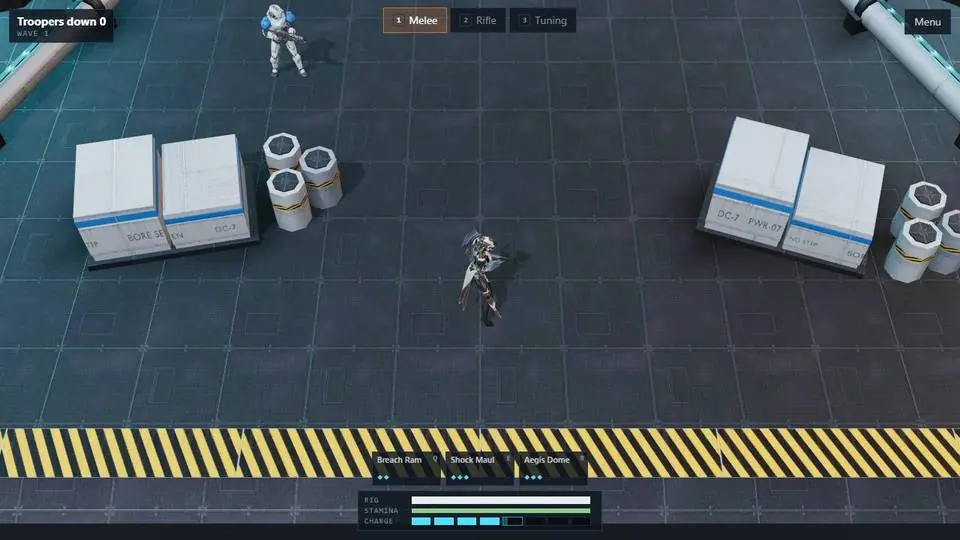
doneBy the end of 7 October there was a page, /play.html, that you could actually play: three fighting styles (melee, rifle and tuning) with seven skills, troopers that come in waves and fight back, health, stamina and Charge, a HUD, and a Dome, a Shock Maul, a rail shot and a split beam to try. When your integrity hits zero a Again screen offers a retry or a different freelancer.
The design rule behind it was interfaces first: loadouts, effects, audio and gameplay were built on separate branches by separate agents, against interfaces that the main session wrote down, then merged within an hour of each other.
Owner: health, Charge, stamina and regeneration, with trooper health bars, added in the same session.
7becf097The first arena on a desktop: a freelancer among cargo crates, with the trooper wave about to start. From the repo · 7 Oct The Aegis Dome skill. From the repo · 7 Oct A rail shot, with the second wave announced. From the repo · 7 Oct Death: a retry or a change of freelancer. From the repo · 7 Oct - 21 7 Oct
Effects and sound, made in code
doneTwo modules arrived within minutes of each other. createFx is an effects module with a bench page at /vfx.html and a realistic pass; createSfx synthesises combat sound from code with no audio files, with a bench at /sfx.html and a listening ticket for the owner, T20.
The owner's brief for both was the same: the weapon and skill effects should read as hyper-realistic, like the player models do, and the menus should look less cartoony. Round two of the effects came the next day.
Owner: the weapon and skill effects should read as hyper-realistic like the player models do.
5031ec95 - 22 8 Oct
A character-creation screen
done/create.html is the new-freelancer screen at final quality: five steps, origin, loadout, look, name and confirm, on a lit pedestal, with each step's choices in a panel beside the character. It runs on keyboard and mouse, on touch at phone size, and with a controller including an on-screen keyboard for the name. One i18n runtime serves both this screen and the demo.
The screens in the repo from this night are worth a look as a contrast with the first mockup: the owner had said an earlier version looked too cartoony, and the pedestal, rim light and dark panels are the answer.
Roadmap: the first screen a player sees should look like the game.
3bf11726Step 1: whose colours do you wear? Directorate, Umbra and others. From the repo · 8 Oct Step 2: what do you carry? Melee, gun and a cast. From the repo · 8 Oct Step 3: who walks off the barge? Pick a body. From the repo · 8 Oct The same step on a phone in landscape. From the repo · 8 Oct
Feel, phones and layered maps
The first real playtest said combat felt clunky. A feel pass, realistic effects, troopers that find their way, device tiers for phones, EU hosting, and the idea that levels should have sky, ground and underground.
- 23 8 Oct
Eleven looks, nine weapons, one asset store
doneThe looks landed overnight: eleven bodies, each in three quality tiers (HD for the creation screen, Game for play, LOD for distance), nine weapons, and clip sets per weapon class fitted at load, so a hammer and a rifle each get the right moves on any body. The creation screen was rewired to the real looks, with portraits, colours and heads.
The weights of all this live outside git. An asset store keeps a manifest in the repository and the files in object storage.
Roadmap: every bought model a freelancer can wear, without hand-animating any of them.
f1016809The look picker once it had portraits for all eleven bodies. From the repo · 13 Oct Picking a head with a controller: the camera pushes in on the face. From the repo · 8 Oct - 24 8 Oct
Device tiers: the phone gets its own game
doneHush Money has to run in a phone browser. The first answer was device tiers. Low, for phones, means blob shadows, no MSAA, lower-detail looks, reduced effects and sound, and fewer draw calls through one draw kind per material and merged statics. Sound on the Low tier caps takes per sound and renders them one at a time, to spare the main thread during warm-up.
The phone is tested on a stand-in, 844 by 390 at three times the pixel density with the CPU throttled four times.
Roadmap: it plays on a mid-range phone browser at 60 fps; that is the north star.
82278594The arena on the phone stand-in, with touch controls. From the repo · 7 Oct A skill effect on the Low tier. From the repo · 7 Oct - 25 8 Oct
Behind a gate, with assets in the EU
doneThe game moved to its own domain, with the server behind a login. Production assets are served from storage in the EU through the server, and the deploy build points the client at it. The build pipeline only deploys for now: a push that only changes docs, the board or tooling notes skips the deploy, on the owner's instruction to save Actions minutes.
The domain is the one place the sources disagree. The chat at the time says the game would start on a hush subdomain of cantorite.com; the naming doc says hushmoney. Both names appear in the docs.
Owner: CI at a minimum, and production stays behind Access for now.
a32411df - 26 8 Oct
A cloud session builds the plumbing
doneWhile the main session fought with levels, a cloud session built what every later system leans on: a debug page with a card for every page and a pages check, a simulation package with a purity check (no page or 3D code in game rules), a seeded random number generator and deterministic maths, and the i18n checks.
The debug page's sound card caught a bug. On a device whose audio output runs at 44.1 kHz, the reverb convolver threw because its impulse response was baked at 48 kHz, which stopped the creation page before its canvas existed. The audio context now runs at 48 kHz.
Roadmap: phase 1 is the foundation; a pure-TypeScript sim is the one decision that is expensive to make late.
da6bb6f6 - 27 8 Oct
The trademark search
doneFacts, not legal advice. A search through TMview, which covers EUIPO, Benelux, the national offices and WIPO Madrid, found no mark live or dead for Hush Money, Hushmoney or Cantorite in the EU or Benelux. The only risk is the many live Hush marks in classes 9, 41 and 42; none covers video games, and hush money is an everyday idiom. A physical board game uses it as a subtitle. Verdict: some risk, low, not blocked.
Owner: you can look these up. The questions for an attorney, if the owner ever files, are written down.
16daab1f - 28 8 Oct
The first playtest: combat feels clunky
doneThe owner played and wrote it down: combat felt clunky, melee should be strong but its reach was low, the magic animation was bad, the enemies were shooting from off-screen. The request was for a 45-degree camera and a zoomed-out view as the defaults, with zoom for the player.
Six stories came out of it and one pass fixed them: the genre's camera, a skill bar where magic works on any weapon, melee that reaches, troopers and rushers that play fair, and casts that follow the weapon. A second review found a nastier bug: with attack held, the dodge never fired, because the combo chained first. It was measured with a latency probe and fixed; held dodges now come out at the same point as tapped ones.
Owner: the combat feels a bit clunky; melee should be strong, but the range is low.
fcb31f6bThe Shock Maul, with lightning and an Aegis dome. From the repo · 7 Oct A combo trail behind a melee swing. From the repo · 7 Oct - 29 8 Oct
Effects get realistic
doneOn the brief to research how others do spell effects, the effects module gained noise, colour ramps, erosion and mesh effects, a readability pass, a beam built in layers, swooshes, fireballs, a dome that warps what is behind it, a death erosion and cast circles. A separate pass added bloom on emissives, heat haze (High tier only) and soft particles.
A bug hunt in the post pass found that a single NaN or Inf glow texel could blank the whole bloom. D3D drops isnan, so the texel is now tested by its exponent bits. Another: when nothing glows, the composite kept showing the last glowing frame, because clearing an MSAA target without drawing does not resolve it.
Owner: I need higher visual fidelity.
fb3f2bfaAll effects at once, before the fidelity pass. From the repo · 7 Oct After: noise, ramps and ring layers. From the repo · 7 Oct The beam in layers, in play. From the repo · 8 Oct - 30 8 Oct
Troopers that find their way
doneEnemy steering got a flow field, firing spots and a pooled set of bodies, so troopers walk round props and take firing positions. A later fix lets a controller or touch swing catch the pack the way the mouse does: the lunge stops when a trooper comes within reach, and with no pointer the swing faces the middle of the pack round the lock.
Owner: the enemies are shooting off-screen and the melee range is low; both get fixed here.
e6785bb8 - 31 8 Oct
Levels with a sky, a ground and an underground
doneThe owner wanted to revisit the generator. The idea: every map is a combination of outside areas that are specific to the world (trees, flora, fauna, sunlight), buildings and underground. The design that followed, layered maps, gives each region a layer and a floor, a filler per layer, hand-built seams between them, and the boss at the job.
It needed more art. The owner shared two cave packs, one whimsical and one an ancient cavern, and they were bought and downloaded. A catalogue of 844 pieces was checked against renders, with contact sheets and a catalogue page, and small agents classified the cave pieces from fact sheets. The owner also noted that Harrowfall has no fauna at all, and said it could, starting with the alien worlds.
Owner: I have a feeling we should be able to create way better maps.
5a0b7bb6A layered map, seed 1, from above: desert ground with the building at its heart. From the repo · 8 Oct The same map as a plan with its zones and the job. From the repo · 8 Oct Alien trees, from the catalogue renders of 844 pieces. From the repo · 8 Oct - 32 8 Oct
A gate for CI, and a limit that is a target
doneThe gate is the one command a branch has to pass: type-check, checks, an asset budget check over every shipped file (classes, meshopt, KTX2, PNG and credits) and more. Three of the freelancer looks were over their player budgets and sat on an allow list with a story each, until a later pass brought all three inside.
The 15 MB first load was meant as a hard limit and the owner softened it: it is a target, and going over warns but never fails. The same afternoon a settings screen arrived in the pause menu: the graphics tier live, volumes, reduced flash, and exporting and importing the save.
Owner: the 15 MB shouldn't be a hard limit.
5bd7c2a9 - 33 8 Oct
“These levels are way better”
doneThat evening the owner deployed the layered levels, had a look and said so, with a question: were these just demos, and could they expand, with more interiors, more underground? The agent came back with six questions. The answers on two of them: put the boss near the job but not predictably, sometimes a few rooms before, maybe even two bosses so you cannot tell; build a few larger setups and pick some at random for each level.
He asked for small agents to set up many rooms with attachable doors, to see if a large library could be made, and handed that to another account's session. The owner went to sleep with one instruction: the top priority is a map designer and level generator that really work.
Meanwhile a phone pass made waves ready before they arrive and froze bodies that stand still. On the 4x CPU stand-in the fight median dropped from 36 to 47 ms down to 28 to 35 ms, and spawn frames that reached 131 ms now stay at 41 to 53.
Owner: these levels are way better. Chapeau.
46f1c13b
The room library, caves and the drill
Small-model agents designed rooms, the owner walked them and flagged what was wrong, and a library grew from 54 rooms to 255, with caves, round rooms, descents, a Harrow style that looked cheap and a Deep-Core Drill that was rebuilt twice.
- 34 9 Oct
Fifty-four rooms from small models
doneThe owner had asked another account's session to see whether a large library of rooms could be made by small, cheap models. The answer arrived on the morning of 9 October: 54 kept rooms, written by small-model designers from a 149-line specification, each checked by script. The checker reads the room file and renders shots; a self-test feeds it 34 deliberately broken rooms and all of them are caught. Reviews from larger models scored the shots and gave a verdict on each room.
A playtest page, /roomlib.html, lists every kept room in a dropdown by type and depth, with previous and next, a sealed toggle and a plan view.
Roadmap: rooms are the content. If agents can build them under a strict checker, the owner only has to judge.
b0bc5a0eContact sheet of the hallway rooms at the game camera. From the repo · 8 Oct Contact sheet of the office rooms. From the repo · 8 Oct Contact sheet of the multi-level rooms. From the repo · 8 Oct - 35 9 Oct
Flag this room, and concept art for every kind of room
doneThe owner would walk each room, so the owner asked for a way to flag one and write what is wrong. A Flag button on the playtest page sends the note, the room, where they stood and the page's toggles into the EU database, and a script lists open flags per room for the agents. The first reaction was that it did not work, and the fix, minutes later, made flags work from the local dev server too.
He also asked for concept art first. An image model produced 20 images of room types, then ten Harrow-overrun rooms for the invasions, then twelve that were explicitly invited outside canon. Every image was looked at, and the design doc records what is worth taking from each. The old Harrow cathedral-style rooms were singled out as the ones liked.
Owner: could you make an option so I can flag a room and mark what is wrong? You can read that from the database.
96ab9b87Concept: a boss room round a crystal reactor. Concept art (AI-made) · 9 Oct Concept: a flooded cave with a central platform. Concept art (AI-made) · 9 Oct Concept: a Harrow seam tearing open a cavern, gold light in the crack. Concept art (AI-made) · 9 Oct Concept: a choir ring of the Harrow's pillars. Concept art (AI-made) · 9 Oct Concept: a lava crossing. Concept art (AI-made) · 9 Oct - 36 9 Oct
115, then 255 rooms: shapes and heights
doneThe library grew in waves through the day. Wave two made 38 rooms in every style, taking it to 115. Then the owner noticed that there were hardly any multi-level rooms, and none in caves, and asked for outdoor height, and for a spiral or a stair down into a door so another room could attach directly, which would let a mission go eight levels down. That became the descent field: a way in high, a way out low. Wave three added 28 multi-level rooms, wave four 13 descent rooms, and wave five 17 more, bringing the total to 255.
Round and octagonal rooms followed in every style, with L, T, cross and ring halls. They came with a problem: a black void around the room where the square one used to sit. The surround pass gives each style its own: a roof, rock, timbered rock or sinking sand. Curved outlines and corners took a second round after the owner's shots showed square corners behind a slanted wall.
Owner: we hardly seem to have multi-level rooms, and in caves I am not seeing any.
410feb49A round cave arena with the black void around it, before. From the repo · 9 Oct The same room with a rock surround that follows the curve. From the repo · 9 Oct A rotunda with a curved wall and a surround. From the repo · 9 Oct The three-tier cave loop, a descent room, after the pass. From the repo · 9 Oct - 37 9 Oct
Falling through the floor of a cave
doneThe owner walked the caves and wrote back with annotated screenshots. The spiral was not really a spiral. On the lowest level of the three-tier loop the owner could walk through one spot and fall through the cracks into nothing. The seams between the raised floor tiles looked unnatural, and the underground lake was missing its shore floor. The new cave floors were liked in principle.
The fixes are in the commits: a modelled rock spiral is allowed and the 3D pipeline can build it, ramps come in several looks, and every cave outline gets a walk test. The final result: every cave room keeps the player on the floor, 88 of 88. That commit was squashed from a branch whose history carried 36 MB of experiment pictures, which is a lesson about what to commit.
Owner: I can fall through the cracks into nothingness.
a191a875One of the owner's annotated shots: red marks on the spiral and the ledge. From the owner's playtest · 9 Oct The spot where a player could walk through the floor of the three-tier loop. From the owner's playtest · 9 Oct Seams on the raised rock floors. From the owner's playtest · 9 Oct The rock spiral in a spire room, two views. From the repo · 10 Oct - 38 9 Oct
The Harrow looks cheap
doneThat evening the owner turned to the Harrow rooms. Many of the Harrow items had graphical glitches, and most Harrow-only rooms looked underwhelming next to the others: low quality, not in the style of the game. The ask was for the fidelity of everything Harrow to be raised so it fits.
Four concepts set the direction, the Harrow's old sites at the game's realistic look. The pass behind it brought real stone, quartz and gold texture sets, mouldings, chips and cracks, and a follow-up sweep for glitches on the old-site stairs, cut walls and rails. A rule had been relaxed earlier that day: glowing gold is the Harrow's, but painted trim and warm colours are fine for everyone else.
Owner: most harrow-only rooms seem a little underwhelming; can we increase the fidelity of everything Harrow related?
7be532f2The owner's shot of an old Harrow site that prompted the pass. From the owner's playtest · 9 Oct A Harrow station hall before the pass. From the repo · 9 Oct After: real stone, quartz and thin gold. From the repo · 9 Oct - 39 9 Oct
The Deep-Core Drill, three times
doneThe drill is the game's emblem, and the owner was hard on it. First thought: if the machine stands on the surface, you would only see the shaft below, not all the pillars. Done. Next: it looks tiny against a player, and when it runs, only the drill itself feels alive, with no smoke, no rubble, and cracks that just exist. Three real-scale concepts with a figure for scale, and a giant drill with five drill rooms, followed.
Then the owner's walk: things shrank and vanished when they got close, which is the camera's see-through fade, and not all the railings worked. The answer was a rebuild with the kit's cutaway, solid rocks and rails, and, from files the owner uploaded, trucks and a landing ship. Fixes kept coming into the next day: rocks and crystals solid where you can see them, the bit lit, cabins that open, and vehicles that are never cut away.
Owner: the current drill looks tiny against a player.
8b5f53ceConcept: the drill rig at real scale, with a figure beside it. Concept art (AI-made) · 9 Oct Before: the first drill rig in a room. From the repo · 9 Oct After the giant-drill pass: bigger, banded, with cables. From the repo · 9 Oct After the rebuild: the bit chamber, with crystals and rock. From the repo · 10 Oct - 40 9 Oct
Thirty degrees, far out, and a level from the surface to the crystals
doneThe last pieces of the day made the library a level. The descent generator chains library rooms from the surface down to the crystals, with a drill mission on top. The owner said the level generator was great and that they would wait for the drill and caves to be reworked, since those bugs still existed. And a camera decision: make 30 degrees the standard, with the camera far away. It is the default on the walk page and in play, and a pass followed for rooms at the new camera, with front-line openings, corner skirts and cave light.
Owner: the level generator is great. Can we make 30 degrees the standard, and the camera far away?
9b5bda41 - 41 10 Oct
The morning walk: cave floors, water and an Unstuck button
doneThe owner walked everything on the morning of 10 October and said they were getting there. The most important point was the caves: the new floor tiles looked bad. The game had gone from realistic pack assets that needed seam work to low quality code-made texture. The answer was floors, ramps and spirals from the pack's own rock, and the code-made texture was dropped. Pools, lakes and rivers got lobes, coves, meanders and shore rocks so they stop being rectangles.
On the owner's phone the bore level had see-through floors at the edges and around the blue alien prop. The descent now builds the caves' rock masses, and the camera cut no longer reaches behind the player.
And there was a request for a button: dashing can leave you stuck, so there should be an Unstuck option in the menu, usable once per 30 seconds, that returns you to the nearest walkable spot you have already stood on. It shipped the same morning.
Owner: we really need an unstuck button for the game.
ff0d2a3bAn underground lake before the water pass, two frames. From the repo · 10 Oct The same lake after it, at the 30-degree far camera. From the repo · 10 Oct The bore's ring on floor 19, before (left) and after the caves were made solid. From the repo · 10 Oct - 42 10 Oct
A tank, and a steel mask we left off
doneThe owner floated an idea: could a mask over every code-built Directorate prop make it look more like the industrial steel? A trial added a steel layer, switchable with ?steel=1. The owner looked at it and said to keep it off everywhere: on the drill it showed artifacts when the ground shook, because the texture stayed still while the model moved. The Directorate can read whiter, which was fine.
The same day the heavy tank was started as a trial, half-built in a factory bay as a room prop.
Owner: keep it off everywhere; the Directorate can read more white, that is okay.
910a4affThe tank in its bay, two views of the steel-layer trial. From the repo · 10 Oct The heavy tank half-built in its factory bay. From the repo · 10 Oct
One weekend to a whole game
The owner asked for everything hooked together: missions, travel, profiles, progression, co-op, raids, assaults, cities, native sites and a second faction. Several agents worked in parallel against one contract.
- 43 10 Oct
One weekend to a whole game
doneOn 10 October the owner asked for a fully playable demo with everything hooked together: enemies, fighting, skills, character creation, missions on top of the level generator, a minimap that shows only explored rooms, a loading screen with the space shuttle and a travelling animation between missions with a briefing, controller detection, graphics presets, profiles and login, achievements, credits to earn and spend, co-op and a tutorial. Three freelancers free to start, more bought with credits. And a ship that lands on the planet you are about to work on.
The plan was one contract and several agents. A TypeScript contract file sits between a run side (missions, levels, travel, tutorial, minimap, debrief) and a meta side (profile, roster, shop, achievements, settings, hangar, accounts, relay). A third agent took the Umbra, the second faction. The main session merged, deployed and did anything that needed the 3D tools or the owner's keys, and the owner had two more accounts that could help, mostly cloud environments, which is why heavy rendering stayed on the owner's machine. 22 stories went on the board that morning.
Owner, on the travel and briefing concept art: that looks exactly what I want.
d394d7caConcept for the travel and briefing screen: a cockpit window with the mission card. Concept art (AI-made) · 10 Oct Concept: the ship above a planet, with the briefing on the side. Concept art (AI-made) · 10 Oct - 44 10 Oct
Progression: loot, grades and the Lattice
doneA fourth agent took progression, in its own files beside the run, meta and Umbra work: fixtures in the world, loot, contract grades and a skill tree called the Lattice. Gear sits on any body, since stats are body-free and pieces hang on the shared skeleton with a maker and a rarity accent. The Lattice has four active skills of its own and a check that its tree rules hold.
Two owner decisions shaped it. Gold may be a rarity colour, relaxing the world rule for loot only, and gear changes happen in the hangar. And death is a retry of the floor: it costs 30 seconds and a Wounded stack that takes 10 percent of max integrity, down to a floor of 60 percent, cleared by a med station. The mission board shows grade chips, locks, a recommended grade and risky ones, and pay is multiplied by the grade.
Roadmap: loot and grades are why you run it again.
491cce68Concept: the Lattice skill tree. Concept art (AI-made) · 10 Oct Concept: loot cards by rarity, from Standard to Relic. Concept art (AI-made) · 10 Oct The mission board with grade chips, from the game. From the repo · 10 Oct - 45 10 Oct
Profiles, sign-in, achievements and a ladder
doneThe meta side built the title screen with a profile picker, a hangar with panels for missions, roster, shop, achievements, co-op and settings, controller glyphs for PlayStation and Xbox pads, and a page of achievements in three tiers, Steel, Teal and Violet, with toasts when you earn one.
Sign-in is optional, because local play is complete without it. An accounts Worker with an EU database sends a six-digit code by e-mail, with specific error texts for rate limits, wrong codes and expired ones. The owner found that the caret in the code field jumped to the start while typing, because the profile panel kept taking the form out and putting it back on; fixed. A ladder, with its own EU database and a signing secret, goes live behind it. Its design rewards what the game is about: a weekly contract with careful and greedy boards, sprint boards, and a quiet board. Every number on a board is recomputed on the server and never trusted from the client.
Owner: could you also think of some stuff like leaderboards?
7a0791cfThe title screen with the profile picker. From the repo · 10 Oct The sign-in step that follows creating a profile. From the repo · 10 Oct The achievements page. From the repo · 10 Oct - 46 10 Oct
Travel: a nebula, a ship and a landing on the real pad
doneBetween hangar and mission the player now watches a journey. The travel screen has a nebula sky with dust lanes and the galaxy's band, 9,000 twinkling stars, the sun's glare and bloom, planets with domain-warped terrain or storm belts and dusty rings, and the freelancer projected as a hologram from the bottom left. Four flyover concept frames cost 12 credits.
The owner steered it with short remarks. The hologram was a bit too bright, so its opacity went from 0.5 to 0.2. There was a black screen before the travel screen, so play.html now paints a boot mark, a turning cyan ring, with no words because the language is not loaded yet. And on 11 October: the landing place looked nothing like where you actually land. The final approach now flies on over the real level and settles onto the run's pad, fading through the surface's own haze. The shop sells ship styles too: the Kestrel and the Sentinel at 50,000 credits each, and a Lancer.
Owner, 11 October: the landing place looks nothing like where we actually land; can we make that happen?
621207b5Concept frame 1 of the arrival flyover: the deck. Concept art (AI-made) · 10 Oct Concept frame 3: the work site. Concept art (AI-made) · 10 Oct The travel screen as built: a ringed planet, the briefing and the hologram. From the repo · 10 Oct Frames from the flyover: the base, the pad, the work site. From the repo · 10 Oct - 47 10 Oct
A loading screen that does not freeze the machine
doneLoading a level is a lot of work, and the owner's first report was that the loading screen froze the computer. The fix was a pacing module that yields frames between pieces of load work, waits longer and shrinks its slices when frames come late, and compiles the shaders a few at a time. Each floor's build, collision and nav grid yield in between.
Then the owner's second report: it was now actually slow, and could we find the middle ground. That took two rounds. The first made slices 1 to 6 ms with two frames for the screen between them, and 1 ms while the player used the briefing. The second grew slices to 14 ms on a smooth machine, one free frame between, halved on late frames, and 2 ms while the briefing is in use.
Owner: the loading is now actually slow; can we find the middle ground?
7f59a7fc - 48 10 Oct
Hold the line, and the Umbra get their own ground
doneHold jobs were a room and a timer until the owner said they should have waves. Now there are five, of 4, 5, 7, 8 and 10 troopers from the rooms around, an elite heading waves three and five, a Wave n of 5 banner, and the next wave when two are left or after 25 seconds.
The third agent gave the Umbra, the second faction, their own site on the planet Nocturne: the Tithe Font, whose job always sits at its heart, and elite skills picked in the briefing. The Sounding, a dig that mirrors the drill's bore, has a yard and a shaft of eight rooms, its bottom floor taking the Umbra's own steel rooms among the caves. It was checked with 50 seeds, 50 of 50 clean. The Font never draws the Directorate's rooms, and before that fix the job reached the heart in 37 of 50 seeds, after it in all 50.
Owner: with holding levels there should be waves of enemies coming.
eb6e2f8aConcept: the Tithe Font on Nocturne. Concept art (AI-made) · 10 Oct The Font's yard in the game. From the repo · 10 Oct A cut hall under the Umbra's violet light. From the repo · 10 Oct An Umbra Hierophant with its ritual circle. From the repo · 10 Oct - 49 10 Oct
The usage limit, and a hand-over
doneNot every entry is a feature. At about 11 on the morning of 10 October the owner reported that the main account was close to its weekly usage limit, about 4 percent of a maximum subscription left, and asked what was worth doing with what remained, floating the idea of upgrading a Directorate model or two. The heavy tank was started. Work would continue on cloud agents after the limit hit, and the owner would make sure uncommitted work got committed if told where it was.
By the afternoon the progression work had stopped at that limit. The demo plan was updated with what was deployed, five work-in-progress branches and their state, and what was still running, and a second update recorded what merged after.
Owner: we are reaching the weekly limit; what would you still do taking into account what the other agents are doing?
60eb004f - 50 11 Oct
Co-op for four
doneCo-op was in the demo ask and ended up at four players. A relay in the EU, one per lobby, routes a four-seat star: a guest's frames go to the host only and the host's go to everyone. A four-card lobby sits in the hangar with join codes and links. Crew play adds Down, Revive, Out and the wipe: the host is the authority on everyone's integrity, a downed player bleeds for 20 seconds and crawls at 1.5 m/s, revival is holding interact for two seconds within 1.6 m, and a player who is Out returns at the gate after 20 seconds.
The headless crew found the bugs. The run page joined its seat only after the level loaded, which on a slow device took minutes, and the relay's 20 second grace deleted the lobby, so both players played alone. A downed player's death clip carried the body out of the reviver's reach, because of root motion. A guest took a crewmate missing from one snapshot as gone for good. All three are fixed, and the co-op check drives two and four headless players through the real hangar and run page.
Roadmap: co-op was later, but every system was to be built with it in mind. The raid needed it now.
1f3581b5The lobby from a guest's side: the job, two seats, ready buttons. From the repo · 10 Oct - 51 10 Oct
Raids and bosses: the Colossus, the Effigy and the Tiller
doneThe owner wanted bosses, and then a raid: a very tough boss with several mechanics, where co-op makes it easier and a solo raid is almost impossible, maybe scaling with players. The Directorate Colossus and the Umbra Effigy came first, code-built units from Harrowfall exported as models, the Colossus as the end of hunt missions and the Effigy at the Font. Then the Tiller, a Harrow titan, with three phases that each rest on two things at once: the Tines that must break together, the Drink at three crystal beds that someone must stand on or tap dry, and the Shed, where the Knell wipes anyone outside a safe zone opened by someone holding a lever.
The raid runs on its own map and over co-op, with the host running the boss and guests drawing it. During playtests the owner found the mech boss had no targeting at all, and that the Colossus's chin guns needed a telegraph. The chin guns are telegraphed and dodgeable now.
Owner: maybe even a raid mission where we have to take on a very tough boss with several mechanics?
73a485d4The Directorate Colossus mid-barrage. From the repo · 10 Oct A seam is cracking: a warning, with the Colossus's volley. From the repo · 10 Oct The Umbra Effigy's beam. From the repo · 10 Oct The Tiller's arena, the apron, in a reaped bed on Fallow. From the repo · 13 Oct - 52 11 Oct
Assaults: take a base with an allied column
doneThe next idea came on 11 October: an attack-raid mission, working with the Directorate to invade an Umbra base, with soldiers and maybe a tank walking with you, a gate to blow up or a stealthy side way. And not only that pairing: it could be the other way round, or rebels against the Directorate. The design is one mission kind parameterised by a pairing, with the Directorate against the Umbra built first.
It uses its own map, no level laid, behind the same shape as the raids so combat, HUD and skills work unchanged. A base has walls, a gate, a culvert, a keep, a core and turret lines, with a pure plan and a check. The tank takes a lane beside the road and the column lasts the push. It was synced over co-op afterwards.
Owner: could we also have an attack-raid style mission, working with the Directorate against an Umbra military base?
562ad90fThe core of an Umbra base, with a charge to set. From the repo · 11 Oct Staging at the pump works, before the push. From the repo · 11 Oct - 53 11 Oct
Cities: Harrowfall’s city generator, at ground level
doneAnother request: ground-based levels. Harrowfall has a city generator with ruined cities in each faction's style, and the owner asked whether the Swarm, Harrow, Umbra and Directorate versions could become runs. The camera is five times closer than the RTS's, so the street is the floor and the buildings are the walls. A run is two or three districts joined at gates where road meets road.
Four cities came across: Fallow, Hivemere, Penumbra and Meridian, each with a mission, such as holding the nerve node at Hivemere or bringing down the Effigy at the Penumbra sanctum. Then a fidelity pass compared Harrowfall's own shot with the version before and after. A phone-memory measurement shows what it costs: Fallow seed 2 before the pass used 169 MB on the GPU, 143 MB after. Meridian was parked until the pass was done and then returned on Harrowfall's street kit, after a war.
Owner: could we create another level idea? City-based runs. Harrowfall has a city renderer.
5bed362cPenumbra: Harrowfall's shot, the first version, and the result. From the repo · 11 Oct Meridian: the same comparison. From the repo · 11 Oct The Effigy waiting at the sanctum. From the repo · 11 Oct - 54 11 Oct
Native sites: the Harrow’s cathedral and the Swarm’s hive
doneThe owner asked for levels where you land on a Harrow site, a relic, cathedral or old city ruin, and the same for the Swarm, so there is some variety. If a faction built it, it cannot be industrial. Not all of them should go down either: some linear, maybe a Harrow spire that goes up.
The sites agent delivered five: climb a Harrow spire with the HUD saying Floor 3, 70 m up; walk a Harrow cathedral in one line, nine halls and no loop, to hang a bell; go down a Swarm hive over two linear floors of grown caves; a town the Harrow reaped; and a Directorate yard the Swarm grew over. On native ground there is no Directorate room, no crate and no steel stair.
Owner: it can't be industrial; and maybe some of these maps are linear only, or a spire which goes up.
d4cd645dThe Harrow cathedral in the Vigil job. From the repo · 11 Oct A Swarm hive floor, grown over natural caves. From the repo · 11 Oct A reaped holdfast, a town the Harrow took. From the repo · 11 Oct - 55 11 Oct
The playtest hits back: guns, doors and a missing target
doneThe owner played the whole thing on 11 October and the list was practical. Enemy turrets hardly felt deadly, being easy to dodge and kill, so they got 300 hit points, 7 by 4 shots every 1.2 seconds and more lead, with the laser telegraph kept. Enemies walked through doors without opening them, so a living hostile within 4.5 m now opens one as the freelancer does. The Directorate's blast doors opened at the RTS's 0.5 a second, so a running freelancer met them half open; now 1.2. The mech boss had no targeting; fixed. On the phone an Elite button now sits beside Swap, so the elite skill can be used on touch.
Owner: enemy turrets hardly feel deadly, easily dodgeable and killable.
fb2fadd0 - 56 11 Oct
Co-op: the host’s units are the only units
doneCo-op passed its first real test with a bug report: a turret killed by one player was still standing on the other's page, and infantry on one page was a turret on the other. The cause was that each page spawned its own enemies. An audit wrote down what is seeded, what belongs to the host and what is a guest's own, and then the rules changed: the host's units are the only units. The Umbra cell gets a puppet mode on a guest page, the level's guns go on the wire with kind, spot and facing, and what is fired is drawn on every page. A check compares the same floors on both pages by kind and spot.
Owner's playtest: a turret killed by one player stood on the other's page.
0f50a853
Modular freelancers, armour and concept art without credits
The freelancer became a set of parts. Seven armour sets and ten weapons were designed and built, concept art moved to a cheaper image model, and a boss that could be shot from 25 m was reworked.
- 57 12 Oct
Inventory, a shop and four ships
doneThe owner's wish list on 12 October was about room: the stash limits should be higher, gear should not dismantle automatically on exit, there should be a mass dismantle with filters, and a full inventory at the end of a mission should be manageable on the debrief screen so nothing is lost. Inventory was also wanted as a buy in the shop and a preview for ships you are buying.
The answers given: a 200-slot stash per freelancer, freelancer slots at 80,000 credits doubling each time, stash room bought 50 at a time, an account vault shared by every freelancer where nothing is ever salvaged automatically, and an overflow that waits so nothing is lost or salvaged without the player.
Owner: gear shouldn't automatically dismantle on exit.
46db1601The account vault. From the repo · 12 Oct The shop's ship page. From the repo · 12 Oct A ship preview: the Kestrel on a turntable. From the repo · 12 Oct - 58 12 Oct
Modular freelancers replace the looks
doneAnother agent had built a modular armour picker at /modular.html. The owner told the main session on 12 October to start integrating it, because these models had to replace the freelancers immediately, with a new character builder. The creator now builds a freelancer part by part, on the shared rig, with sets 01 and 02 bought with credits, an Owned-only filter and arrow pickers; two-handed grips use left-hand IK. The eleven old looks stay for faction bosses and elites.
The owner then made a freelancer, edited everything, and found everything had gone back to the default on saving. The cause: the accounts Worker runs the client's profile rules, and deployed by hand it had fallen behind, so it dropped the new outfit field on every sync. Since then every deploy ships the Workers too.
Owner: it did create the freelancer, but everything went back to the default. It's not saving changes.
213d56f9 - 59 13 Oct
Concept art without burning credits
doneBy 13 October concept art was being made faster than the old tool could sensibly support. The owner asked whether it could be done on a local machine or more simply. The research and a proof of concept answered it: a hosted image model in the EU. The heretic-armour prompt was replayed on it, and both a small and a large model worked.
The rule that followed, rule 13 in the project's rules: the small model for concepts and trials, the large one for images in use. Later that day the old tool's text-to-image was switched off, and it stays for image-to-3D only. The same rule was written for Harrowfall.
Owner: 4b for concepts and trials, 9b for the actual usage.
326dde8fThe heretic set replayed on a fast model. Concept art (AI-made) · 13 Oct The same prompt on klein 4B, the concept tier. Concept art (AI-made) · 13 Oct The same prompt on klein 9B, the one used for images that ship. Concept art (AI-made) · 13 Oct - 60 13 Oct
Seven armour sets and ten weapons
doneWith the picker in place, agents produced concept sheets for seven armour sets, one per faction or maker that canon supports, and ten freelancer weapons on five sheets, plus a proposal for ten skills and eleven unlockables. The owner picked which sets and the top three weapons to build first. The source rule is firm: armour comes from one bought sci-fi pack on the owner's drive, which is fully modular, and nothing else.
Sets arrived through the day, each built with a kitbash pipeline and put in the creator, the bench and in play: Heretic, which includes a Penitent blade and Censer rifle; Hollow Veil; Tollkeeper from the Tollway; Molt, the Uncounted's carapace; Touched, the Hollowmere diggers; and Vigil, the Hush. The owner asked whether it was intended that the heretic set was only a few pieces, and later said that the Hollow Veil's hood looked cheap, so it got a cloth pass with twill, folds, hems and seams.
Owner: the cloth hood of the Hollow Veil does look a bit cheap. Can we give the hood some texture as if it were real cloth?
755a9743Concept: the Hollow Veil. Concept art (AI-made) · 13 Oct Concept: the Tollkeeper. Concept art (AI-made) · 13 Oct Concept: mono-edge blade and capacitor maul. Concept art (AI-made) · 13 Oct The Hollow Veil in the hangar after the build. From the repo · 13 Oct The Tollkeeper. From the repo · 13 Oct The Vigil. From the repo · 13 Oct The lineup: the sets standing side by side. From the repo · 13 Oct - 61 13 Oct
The Colossus had no safe distance
doneThe owner fought the Directorate mech and found it doable, then looked at the raid bosses and found the Colossus could be shot down from 25 m with no phase that changed anything. The rework has no safe distance and three phases, and gives both range and melee a job. The Colossus that guards normal hunt missions would have changed too, so the owner asked whether that one should be easier. It is: the hunt gets a lighter ruleset.
Owner: the Colossus that guards normal hunt missions should be easier, with less health and damage.
00b33916The Colossus arena's gate, before the arena rework. From the repo · 13 Oct After the arena rework. From the repo · 13 Oct - 62 13 Oct
City buildings, made in-house
doneThe city districts looked flat, and the owner asked whether to buy a 3D city pack or generate our own. The test was done on the local machine: concept images from the small model, three picked and re-run on the large one, then a self-generation proof of a few Earth and Umbra buildings. The owner's follow-up was the right one: how does it look close up, at this game's size, when the player walks past them? Six Penumbra buildings came with baked colour and emission textures, then all of them with new textures and more buildings, plugged into the city generator as umbra and Meridian building packs with collision baked.
Owner: would you buy an existing 3D pack, or generate our own and work from there?
2d27f7f1Concept: a Penumbra district from above, on klein 9B. Concept art (AI-made) · 13 Oct Concept: a Meridian district. Concept art (AI-made) · 13 Oct A built-in-house Meridian tower at the game camera. From the repo · 13 Oct - 63 13 Oct
The first press shots
doneThe owner needed a short description of each game for a website, concept art for both, and a catchy first image. For Hush Money, the new armours were wanted. So there are two kinds of pictures here: freelancers at hero camera in the hangar, and fights in the game, one in an interior, one in a cave and two against bosses. The owner also asked whether the graphics settings in the shots were the highest.
Creator concept images were also made with the image model, to put around the freelancer creator.
Owner: for both games we need a catchy first image; for Hush Money I'd like to see the new armours too.
689708f0A fight in an interior. From the repo · 13 Oct A fight in a cave, with a shield dome. From the repo · 13 Oct The Directorate mech. From the repo · 13 Oct The Umbra mech. From the repo · 13 Oct
Cloth, coats, shields and a tune-up
Capes with physics, a greatcoat, all seven shields and a power shield, a performance sweep, renders on the GPU, and a repo that finally has the right name.
- 64 13 Oct
A cape that moves
doneThe owner asked how hard cloth simulation would be, whether libraries exist, and whether it could be hooked to the modular character's cloth armour. The research found no drop-in cloth for skinned characters in the 3D library, so a small solver was written: Verlet particles with distance constraints, capsule collisions, each particle held within a distance of its skinned rest position, in the character's own frame so that walking and teleporting cannot explode it. Then a proof with a cape: a generated texture on a mesh built in code, with physics.
The first versions had problems. A blank stage because of float attributes. The cape hovering above the shoulders and away from the neck, the owner said, and wanting folds and seams. A rebuilt cape with neckline, yoke, pleats and seams, 13 by 20, came next. The review the next morning: the underside did not fall and the gap between the cape and the lower back was too big.
Owner: how hard would it be to create cloth simulation?
44fb9036The concept for the cape: turnarounds of a mannequin in an ochre coat. Concept art (AI-made) · 13 Oct The cape in the creator, from behind. From the repo · 13 Oct From the side, in motion. From the repo · 13 Oct On the Vigil set. From the repo · 13 Oct - 65 14 Oct
Cloth on a budget
doneA cape that moves is easy on a desktop and expensive on a phone. The tier rules: cloth costs 0.6 ms a frame on High and 1.5 ms on the Low phone stand-in. On High, the player and up to three others simulate; on Low only the player does, and enemies never do. A frame-time guard with hysteresis degrades gracefully when overloaded, others first and the player last, down to the static fallback. Settings gained Cloth physics: Off, Auto or High, in the pause menu and the hangar.
Roadmap: every effect has a budget, and the budget is a check.
1456e15a - 66 14 Oct
A greatcoat in three panels
doneThe solver was built so a coat is data, not a rewrite. The coat has an upper and three skirt panels, as set K in the creator. Round three of the cloth work had already given the cape a body-hugging yoke, soft defaults and fold keeping. Limb clearance for a coat that hangs to the legs went on the board as a story.
Owner: next on the list is a long coat.
b402fa8fThe coat in the creator, three-quarter view. From the repo · 14 Oct The skirt panels from behind. From the repo · 14 Oct The coat over the Vigil set. From the repo · 14 Oct - 67 14 Oct
Shields: two of seven
doneUntil now the only shield was the power shield. On 13 October the owner asked for concept art of shields that fit the game, and seven came back. On 14 October the order was to build all seven. The first two came in at midday: the Toll plate and the Cordon pavise, with a shield recipe and tools for the rest. The owner noticed that the shield models another agent had added were not in the armour picker yet and asked a small agent to wire them in.
The other five followed within two hours, each built by an agent from the recipe: the Veil guard, the Wreck slab, the Still plate, the Tally carapace (the first organic shield, after one review pass) and the Ward shard, in its canon-safe variant with no crystal through the plate. The owner then asked for a power shield of the game's own, and the Shade field, a forearm emitter with a hard-light field built in code, was merged at 14:44.
Owner, 14 October: build all seven shields.
21c7540eConcept: a sheet of 4B trials for the shields. Concept art (AI-made) · 13 Oct Concept: the Toll plate. Concept art (AI-made) · 13 Oct Concept: the Cordon pavise. Concept art (AI-made) · 13 Oct The Toll plate, built: a contact sheet of poses. From the repo · 14 Oct The Cordon pavise, built. From the repo · 14 Oct The Tally carapace, the grown shield of the Uncounted. From the repo · 14 Oct The Ward shard of the Touched, in a run. From the repo · 14 Oct The Shade field: a forearm emitter and a hard-light disc. From the repo · 14 Oct - 68 14 Oct
A performance sweep, honestly reported
doneSix Haiku research agents read the code and listed 46 suspected performance problems. Nothing was profiled, so each one was a lead. An engineer then checked every item: 11 were real and fixed, 34 were false or not worth it, one was deferred. Three more fixes were found while checking, among them a failed path search retried every frame.
The counters show real effects. A path-finding cell that made 557 calls in 12 seconds, 548 of them failures, now waits to replan. Material version bumps in a raid fell from 13,778 to zero in 10 seconds. The hangar's ship preview had a 2,037 ms long task that is now 111 to 265 ms. Audio warm-up on the main thread went from 6,176 ms to 431 ms, with the work moved to a worker.
The frame-time comparisons were inconclusive and the doc says so: the machine was shared with three other agents' runs, and a base run's own median moved between 20 and 50 ms.
Roadmap: measure first. The doc's verdict column is the evidence, not the headline.
f613649a - 69 14 Oct
Renders on the GPU
doneThe owner saw the 3D tool using a lot of the GPU and asked whether it was offloading properly or whether this was normal. The outcome was a rule: renders and bakes run on the GPU with a CPU fallback, through one shared helper. The same day the creator froze while editing a freelancer, which went on the board with the optimisation sweep as a story.
Owner: can we add this to the rules, to use the GPU?
38399b26 - 70 14 Oct
The repository is Hush Money now
doneA week after the rename in the product, the repository followed: Cantorite-Undertone became Cantorite-HushMoney, and the roadmap sync was told. The servers were renamed. The code name Undertone stays only where renaming would orphan data, like the database of saved rooms. Production is public except the room API, on the owner's instruction, and the title screen has a BETA badge under the title.
Where the history stood that day: 1,587 commits on develop in ten days, 545 issues on the board, and a game with a title screen, a hangar, a roster, a shop, missions on generated levels, raids, assaults, cities, co-op for four and a creator with cloth. It is not finished. Four hundred of the issues are open.
Owner: production is public from 14 October, the room API aside.
08148b6bThe title screen, with a sign-in prompt over the nebula. From the repo · 11 Oct The freelancer lineup in the hangar. From the repo · 13 Oct
A release button and a new skill system
A release pipeline and three hitch fixes, then the owner's call to rebuild the skills: block off every button, a tree per weapon, a bar of six, painted icons, one bindings table and a touch layout with a split attack and dodge button. Designed, answered and playable in one evening.
- 71 14 Oct
A release button, as in Harrowfall
doneThe owner asked for the release pipeline the same afternoon the repo was renamed. Develop now promotes itself to acceptance, a second site called hushmoney-acc with its own relay and its own EU storage, and opens a release pull request into master. Merging that pull request is the owner's release button, and a merged release deploys production. Branch rules hold the branches to it.
The pipeline was live by 16:41. The owner pressed the button three times in the days that followed: on 14, 15 and 16 October.
Board: the release pipeline, at the owner's request on 14 October (#49).
c4543275 - 72 14 Oct
No more freezes when a room wakes
doneThree fixes for hitches that players could feel. Editing a freelancer in the creator froze the page; textures are now decoded and uploaded in bands, and the first draws are warmed before the swap. The load side of the performance sweep moved the layout, the walk path and the Harrow lattice into workers.
The worst one was in play. The creature bodies warmed up at load sat under the ground for two frames and were culled, so the first room with a Swarm pack compiled its materials mid-fight: freezes of 5.9 and 2.9 seconds. They now wait hidden in the scene. On the test seed the worst frame went from 5,882 ms to 53 ms. In the same commit a boss stopped standing inside props, and a melee blow is now tested against the rim of its body, not its middle.
Roadmap: the creator freeze (#537) and two room hitches (#552, #553).
b9fa495a - 73 14 Oct
Shield guard: a blue pool over integrity
doneWith seven shields in the game, a shield needed to do something besides look right. A shield carrier now has guard: a pool of 20 points over integrity that takes hits first and, four seconds after the last hit, refills over three. The HUD draws it as a blue segment at the end of the integrity bar. The first blue read too pale over the white fill and was made deeper.
Co-op got the same rule: the host keeps each crew member's guard, and the check was extended so the first guest carries a shield and their guard is hit first on both pages.
Design: shield guard, a pool over integrity for shield carriers (#565).
2a29ca32A shield carrier in a run, with the guard segment at the end of the integrity bar. From the repo · 14 Oct - 74 14 Oct
Block comes off every button
doneAn hour after guard landed, the owner took block off the controls. The key, the right mouse button, the pad's left trigger and the touch button no longer block, but the mechanic stays in the simulation, so it can come back with a one-line rebind. The tutorial's block step became a rifleman: dodge his shots twice and the step is done.
“Remove guard completely from the game. For now just the button. Leave the mechanics for if I want it back.”
196035cb - 75 14 Oct
The skills rework, on paper
doneThe owner asked for a different skill system. The design that came back the same evening has a bar of six chosen skills and an item, the same on desktop, a pad and touch. Each weapon class has its own tree (one-handed blade, two-handed blade, shield, polearm, pistol and rifle, with dual wield later), and the disciplines share trees of their own. Ranks, mods and forks are folded into the trees, and the Lattice stays as the passive web. There are two point pools, 32 for the trees and 18 for the Lattice at level 30.
The owner answered three questions in ticket T64 within the hour. The job's elite card gets a slot of its own beside the six. Raise Shield is a skill a carrier picks, not a default. Schematics stay as six rare prototypes and six early schematics. The rework went on the board as 24 stories.
PLAN.md, the decision of 14 October, and docs/phases/skills-rework.md.
de3a684bMockup: the tree page for the two-handed blade, with a fork and the level gate. Mockup · 14 Oct - 76 14 Oct
Painted skill icons
doneEvery skill needed an icon that reads at 48 px in a round glass slot. An art direction set one motif per icon and a colour key per tree, with no gold, because gold belongs to the Harrow. Then a generator turned a manifest of skills into image prompts. Five styles were tried on the small model and painted won. The 16 finals were made on the large one.
The owner sent back three: Aegis Dome, Overclock and Second Wind. They were redrawn as an empty hex-cell dome on a steel deck, a worn rifle with glowing vents, and a pod breathing out green. That night a second batch added the new tree skills, the six prototypes and the twelve job cards: 42 icons shipped.
docs/art/skill-icons.md: the art direction, the costs and the lessons.
48358695The 16 first icons, square and in the round slot, at 128 and 48 px. AI-made. Concept art (AI-made) · 14 Oct - 77 14 Oct
One bindings table and a Controls screen
doneSix skills, an item, a job card and a dodge on every device needed one place that says which input does what. Every action now reads from a single bindings table with two presets, Standard and Mirrored. A Controls screen in the settings remaps keyboard and mouse, the controller and touch. A clash asks whether to swap, replace or cancel, and key letters follow the player's own keyboard layout. One glyph helper draws the keys in the HUD and the menus, in English and Dutch.
Board: the bindings rework (#597, #161).
d924c78aMockup: the Controls screen, with a clash being resolved. Mockup · 14 Oct - 78 14 Oct
Six slots, an item and a job card, in the run
doneBy midnight the rework was playable. The skill data and the tree rules are data with a check. Progress saves moved to version 2: every point spent before came back, with free respecs until the next extraction. Four Lattice nodes that only gave active skills were cut. In a run the six slots fire through the bindings, and a skill of the weapon not in hand swaps and fires on the same press.
The HUD bar was rebuilt to match. On touch, layout A puts the six skills on an arc around a split button, attack on one half and the dodge roll on the other, with a small item area beside the swap button that flips between the item and the job card. The hangar gained a tree screen and a Skill bar tab to pick the six from the skills a freelancer owns.
docs/phases/skills-rework.md: the build order; the core merged as cdf874f5.
607735fbTouch layout A on a phone held sideways: the arc, the split attack and dodge button, the swap. From the repo · 15 Oct - 79 14 Oct
The Colossus stops sinking
doneIn a phone playtest the owner saw the Colossus sink into an uneven cave floor. The legs were posed by fixed angles, so the walk's lift and the kneel straightened them and pushed the soles up to 0.95 m into a flat floor and 1.6 m into cave rock. Now the feet lead: each foot is placed on the ground sampled under its heel and toe, the hips drop with the body's bob, crouch and kneel, and the knees bend to fit. The Effigy got the same legs.
From the owner's phone playtest; docs raid-colossus.md 9.1 has the numbers before and after.
1e95816c
Rooms a boss can be fought in, and prices that take work
After a phone playtest, bosses only appear in rooms with space to fight them, and seven new arenas at three depths were built. Prices and levelling were set against 55 measured runs, and the desktop skill bar got smaller.
- 80 14 Oct
A boss only in a room that fits
doneThe same playtest put the Colossus in a narrow cave between rock and lava. The level generator now measures each room's floor, with its walls, cover and lava, against a rule per boss class. A floor whose job brings a boss takes a room that fits, and the job stands at the fitting spot nearest the middle, at least 12 m from every doorway.
Over 50 seeds, 104 of 250 bosses had been in rooms that failed the rule; afterwards none were. The cost is fewer rooms to choose from: the descent's boss job takes 6 rooms where it took 17 to 19. Ticket T66 asked the owner to fight three of them; the answers asked for more arenas, at three depths.
“Hardly room to dodge or fight.”
4ed57bddBefore and after: the Colossus in a cave between rock and lava, and in a room that fits it. From the repo · 14 Oct - 81 15 Oct
What a run pays, and what things cost
doneThe unlock prices had been test values. To set real ones, 55 runs were played headless by the autopilot and their pay was measured. A model was fitted to them and a check counts how many runs each unlock costs. The owner's answers in ticket T65 slowed levelling to level 30 after about 150 runs, with XP at a third of its old pace, and tripled the armour prices to 4,500 and 2,400 credits a piece, 25,200 for a seven-piece set. The check fails the build if either drifts out of its band.
Owner, T65: slower levels and armour sets at triple price.
3f5350d6 - 82 15 Oct
A smaller skill bar on desktop
doneThe new bar was too big on a monitor. After a study of desktop HUDs in the genre it was rebuilt compact. At 1080p it now takes 29.6 % by 10.8 % of the screen, down from 46.5 % by 18.1 %, and it scales with the screen height, so it holds the same share at 1440p and 4K. The touch arc was left as it was.
Board: a smaller desktop skill bar (#610).
cc60f915Before: the first new bar at 1920x1080. From the repo · 15 Oct After: the compact bar, same scene. From the repo · 15 Oct - 83 15 Oct
Boss arenas at three depths
doneSeven new boss rooms were added to the room library, built from the existing kits. Two are at the surface: a tank assembly hall with the tank half-built in its bay, and a proving hall under a control gallery. Three are deep: a rock terrace, a still pool with a causeway and a mine bay under a gantry. Two are very deep: a crystal crossing and the monolith hollow.
The Colossus was fought in all seven at the game camera, on desktop and on a phone. The fights showed dark cut tops on tall rock seen from the floor, which went to the environment artist as a story. Ticket T67 asks the owner to play three of the new rooms.
Owner, T66: more boss arenas, at surface, deep and very deep.
c29dd4a0The tank assembly hall, a surface arena. From the repo · 15 Oct The still pool, a deep arena, fought at the game camera. From the repo · 15 Oct
A bar per weapon, a quick-swap pistol and an iPhone build
The loadout settled: a skill bar for each weapon, the pistol as the gun you swap to, a slot picker on the phone, frames that fit their weapons, a notice centre, and an iOS shell that builds test versions from develop.
- 84 15 Oct
A skill bar per weapon
doneOne bar for both weapons meant gun skills on the bar while the blade was out. Now there are two bars, a melee bar and a gun bar, and the one on screen swaps with the weapon. The faces that change turn over, the ones that stay put stay still, and the weapon badge flashes. With reduced motion it is a cross-fade. An old single bar is split by source, with a one-time notice. The loadout and the tree page each pick which weapon's bar they show.
Board: a skill bar per weapon (#616).
2281b077The bar mid-swap, slowed for the still. From the repo · 15 Oct The tree page with the polearm's tree. From the repo · 15 Oct - 85 15 Oct
The pistol as the quick-swap gun
doneThe pistol got a job: the gun you swap to for a moment. It draws in 0.12 s, and a window of 1.2 s after the swap, Snap Draw, cuts 0.5 Charge off its first skill. Two new skills fill its tree, Suppressed Shot and Fan Fire. A blade swing after the pistol is primed and hits for 30 % more, or 60 % with the Gun and Blade notable. A headless check plays the whole loop on desktop and phone.
skills-rework.md 7.5: the pistol's numbers against a trooper and an elite.
53c77b14A primed blade hit after a pistol swap. From the repo · 15 Oct - 86 15 Oct
A notice centre, and two hangar fixes
doneMessages such as a free tree reset or a new weapon used to show once and vanish. They are now kept in the profile, up to 40, behind a Notices button in the hangar with an unread count, and every toast goes into one stack. Two fixes came with it: the first click after switching from keys to the mouse was lost on the skill tabs, and on a phone the item and the job card wrapped apart. The same evening the owner said merges into develop no longer need asking.
“Yes you can merge whatever on develop. Thats where it is for.”
135382c9The notice centre open in the hangar. From the repo · 15 Oct - 87 16 Oct
A slot picker, and a smaller freelancer on a phone
doneSetting the bar on a phone meant picking a card and then a slot. Now a tap on a slot opens a picker for it: every owned skill allowed on that bar, grouped by tree, with its noise, Charge and cooldown. It opens as a popover on desktop and as a sheet on a phone. On the hangar's skill panels the freelancer shrank from 15 % to 6 % of an upright phone, and from 30 % to 12 % of a sideways one. A crash that blanked the roster for one unknown weapon id was fixed the same night.
Board: bar-slot-picker (#628) and the roster crash (#629).
f4a76f38The slot picker on desktop. From the repo · 16 Oct The slot picker as a sheet on an upright phone. From the repo · 16 Oct - 88 16 Oct
Weapon frames that say what they fit
doneA bug showed the problem: equipping a maul frame swapped a sabre and shield for a great sword. Weapon frames now have generic names and say which weapons they fit; parts that don't fit the weapon in hand are stowed and never counted. There is a Shield slot that gives guard, and rigs are stats only, with no look of their own. A simulation of 1,000 freelancers first had sabre and shield 24 % ahead. With shields no longer rolling integrity lines the gap is 3.4 %.
progression.md 16 and 17; the board's frames rework (#633).
e649a654The Refit with a sabre and shield, picking for the Shield slot. From the repo · 16 Oct - 89 16 Oct
Hush Money on an iPhone
doneThe game got an iOS app: a native shell around the built client, the same setup as Harrowfall's, with Hollowcut's bundle id and a cloud build. The pages run from the app bundle, so the relay and the asset store were taught to accept the app's origin. The first build failed every sign-in code: the platform only sends cookies back to cantorite.com pages, and the app is not one, so those calls now send cookies only from a sign-in host.
The shell was merged into develop on 17 October, and iPhone test builds now come from develop. The platform added a button that starts the cloud builds for the iOS apps.
The iOS app's notes and the platform's test-build design.
e7835d34 - Port 24 Oct
Planning a native client
in progressHush Money starts the same move Harrowfall made: from a browser game to a native client for phones and desktops. The lessons from Harrowfall's port were written down first, then a port plan in small steps and an audit that sorted 481 player-facing files. The first steps landed the same day: a project skeleton with the agreed settings, translations in the new client's format, and the synthesised sounds rendered to audio files. Also new: a short app name under the home-screen icon.
07d03530, d4a3cefe, aeb3deee, 627e7fad, f44c0c30
What the plan still holds
From PLAN.md on 17 October: phase 0, pre-production, is still open with the skills rework inside it; the foundation phase, the hub and the release candidate follow. The board has 623 issues, and 183 of its items are done.
- N1 Later
The foundation phase
plannedPLAN.md's phase 1: the simulation running in a Web Worker on a fixed tick with capped catch-up, the renderer and platform services behind interfaces, device tiers, suspend and resume, and CI that enforces budgets, determinism and i18n from the first push. Proved on a thin arena, not on new content.
PLAN.md, phase 1 and docs/phases/01-foundation.md.
- N2 Later
The hub, reputation and the release candidate
plannedThe Tollway barge Patience as the hub, with a fence, a refit bay and a graft clinic, and reputation with the Directorate, the Umbra and two minor factions; more disciplines and worlds; the Tiller as a full boss; Fallow as the endgame. Then onboarding, accessibility, a PWA, an Electron build for Steam and Steam Deck verification.
PLAN.md, phases 7 to 14.
- N3 Later
Later, only if it earns it
deferredA console port, through a porting partner. Reach-wide Resonance seasons, the Sanctum Procession set-piece and more homeworlds.
PLAN.md, the later row. Consoles are a nice-to-have; docs/platforms.md says what keeps a port cheap.
Sources: the git history of the game's develop branch (about 1,845 commits, 5 to 17 October 2026), its design docs, the project board (623 issues; 545 on 14 October) and the owner's working chats. Dates are commit dates; the repo was called Cantorite-Undertone until 14 October. Pictures are the game's own renders and screenshots, the owner's annotated playtest shots, code-built concepts and, where marked, AI-made concept art; none is retouched. The game is in development; production is an early public beta.